
Asbestos abatement isn’t a cleanup job — it’s a tightly controlled procedure for removing a hazardous material without letting a single fiber go airborne. For Las Vegas Valley property owners with a pre-1980 building, it’s what turns a positive asbestos test into a home or workspace you can safely renovate. This guide covers where asbestos hides in older Vegas properties, who tests versus who removes, exactly how the abatement process works start to finish, what it costs locally, and the regulations that keep it safe and legal.
Quick Facts
Most at risk: Buildings built before about 1980 — asbestos was phased out gradually through the 1980s, not banned overnight.
Who tests vs. who removes: An independent, accredited inspector samples and lab-tests the material. Pinpoint doesn’t test in-house — that keeps the result unbiased. If it’s positive, our team performs the abatement.
The standard: All work follows EPA NESHAP and OSHA worker-protection rules, with Clark County DAQ permitting.
How it’s contained: Sealed work zone, HEPA negative-air pressure, wet removal, double-bagged disposal at a permitted landfill with a tracked manifest.
How it’s verified: A third-party industrial hygienist does the final clearance air test — not us — before the containment comes down.
Who handles it: Pinpoint is a licensed Nevada abatement contractor (#0084981) serving Las Vegas, Henderson, and the surrounding valley.
In This Guide
- What Asbestos Abatement Is
- Why It’s in So Many Las Vegas Valley Buildings
- The Health Risk in Plain Terms
- Who Tests, Who Removes
- The Abatement Process, Start to Finish
- Clearance: Proving the Air Is Safe
- The Regulations Behind It
- What Abatement Costs in the Vegas Valley
- Asbestos After Property Damage
- Pinpoint Field Note
- Frequently Asked Questions
What asbestos abatement is
Abatement is the controlled removal and containment of asbestos-containing materials (ACMs) from a building. It’s not a vacuum-and-gloves job — it’s a planned sequence that isolates the hazard, removes it wet to suppress fibers, and cleans and verifies the space before anyone returns. The single goal driving every step is keeping microscopic fibers from becoming airborne, because that’s the only form in which asbestos is dangerous.
That distinction is why abatement and “demolition” are not interchangeable words. Tearing out a popcorn ceiling with a scraper takes an afternoon; abating one means building a sealed work zone around it first, and proving the air is clean afterward. The removal itself is the short part.

Why it’s in so many Las Vegas Valley buildings
Asbestos was the “miracle mineral” of mid-century construction: cheap, strong, and excellent at resisting heat and fire. Builders mixed it into insulation, roofing, siding, floor tile, drywall compound, and textured paint. That’s why so many properties from the 1920s through the 1970s contain it.
The phase-out was gradual, not a clean cutoff. The EPA began banning specific asbestos products in the 1970s, more followed, and by 1986 most manufacturers had stopped using it — though existing stock kept getting installed. The practical takeaway: if the building went up before 1980, assume asbestos may be present until a test proves otherwise. Properties into the late 1980s can still contain it.
The Las Vegas Valley has a large stock of exactly this vintage — mid-century neighborhoods in the central valley, 1960s and ’70s tract housing, older Henderson subdivisions, and plenty of small commercial buildings that have been remodeled repeatedly. In those properties, asbestos can hide in more places than people expect:
- Insulation: Around pipes, boilers, furnaces, and HVAC ducts — often a white or gray wrap or a hard, cement-like coating.
- Flooring: Vinyl tile, sheet flooring, and the black mastic adhesive beneath — common from the 1950s through the 1970s.
- Ceilings and walls: Popcorn and textured finishes, drywall joint compound, plaster, and textured paints.
- Exterior: Cement-based roofing shingles and siding, added for strength and fire resistance.
Watch especially for these materials in poor condition — cracks, tears, crumbling, or water stains — because deterioration is what starts releasing fibers. If popcorn ceilings are on your list, our popcorn ceiling guide covers that material specifically, and our test-before-remodeling guide covers what to do before a renovation.
You cannot tell whether a material contains asbestos by looking at it — only a lab can. That’s why the process always starts with testing.
The health risk in plain terms
Asbestos is harmless sitting still. The danger begins when materials are damaged or disturbed and microscopic fibers go airborne — you can’t see, smell, or taste them. Inhaled over time, they’re linked to asbestosis (lung scarring), lung cancer, and mesothelioma. The unsettling part is the latency: symptoms can take 10 to 50 years to appear, and the risk is cumulative, which is why caution around suspect materials matters even for brief exposures. The EPA outlines the health risks of asbestos in the home in detail.
This is also the reason the honest answer to “should I just leave it alone?” is often yes. Intact, undisturbed, well-maintained material is generally safer left in place than disturbed by an untrained hand. Abatement becomes the right call when the material is deteriorating, or when a remodel, a leak, or damage is about to disturb it anyway.
Who tests, who removes
This is the part worth getting straight before you hire anyone. Testing and abatement are two separate jobs, handled by two separate parties on purpose.
Testing is done by an independent, accredited inspector. They identify suspect materials, collect samples, and send them to an accredited lab that confirms whether asbestos is present and at what concentration. Pinpoint does not perform that diagnostic testing in-house — an independent result has no stake in the outcome. Need a tester? Call us and we’ll refer you to a trusted accredited inspector.
Abatement is done by a licensed contractor — that’s us. Once a sample comes back positive, Pinpoint (Nevada license #0084981) plans and performs the asbestos removal in Las Vegas under EPA NESHAP standards. The only testing-type work we do is the air monitoring during our own abatement and the final clearance on our own job — and even that clearance is run by an independent third party (more on that below). Keeping the inspector and the abatement contractor separate protects you: the party that tells you whether you have asbestos has no incentive to sell you a removal.
The abatement process, start to finish
Planning and containment
Once testing confirms ACMs, we build a detailed plan — what’s being removed, how, and how the waste leaves. Then we isolate the work area with heavy plastic sheeting and run negative-air machines with HEPA filters. Negative pressure means air flows into the contained zone, never out, so even a small breach can’t release fibers into the rest of the building.
Wet removal and worker protection
We saturate the material with amended water (water plus a surfactant) so fibers stay heavy and grounded, then detach it in manageable sections — no dry breaking or crushing. Crews work in full disposable suits and fitted P100 respirators, and we monitor air on each worker and in the zone throughout to confirm exposure stays within OSHA limits.
Disposal with a paper trail
Removed material is double-bagged in six-mil polyethylene, labeled with asbestos warnings, and transported in covered, leak-tight vehicles to a landfill permitted for asbestos. Every load travels with a manifest — a chain-of-custody record proving the waste went where it was supposed to. You get signed copies in your project file, which matters if you ever sell or renovate.
Our Asbestos Abatement Process at a Glance


← Swipe through our 6-step asbestos abatement process →
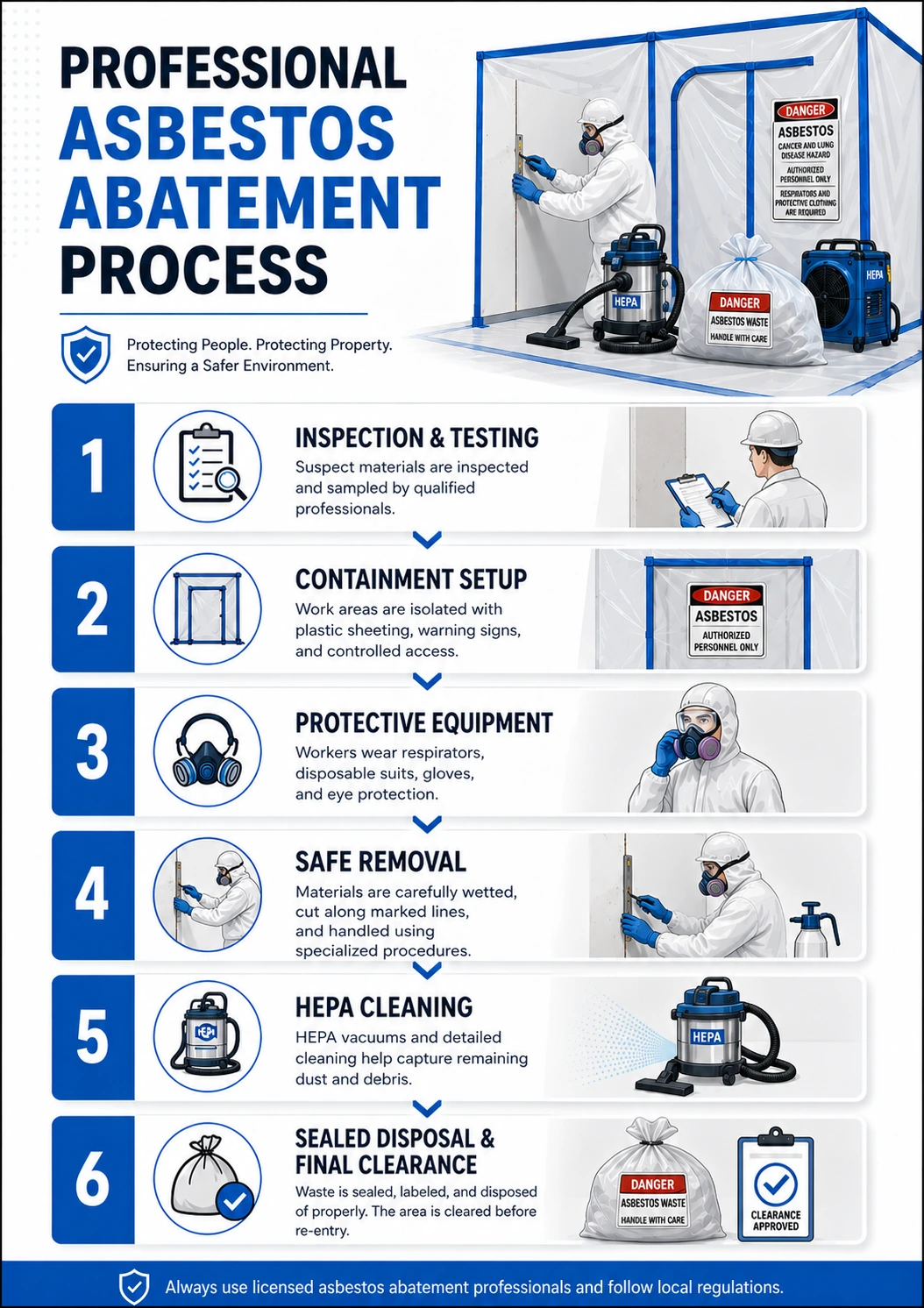
Clearance: proving the air is safe
Removal isn’t the finish line. After the bulk material is gone, we HEPA-vacuum and wet-wipe every surface to capture fine particulates. Then comes the verification step that actually clears the job: a third-party industrial hygienist — independent of our crew — takes final air samples and has them analyzed. Only when fiber counts come back well below regulatory limits does the containment come down. That independence is the point: an outside party confirming the air is safe is worth far more than our own say-so.

The regulations behind it
EPA NESHAP
The National Emission Standards for Hazardous Air Pollutants is the federal backbone — it governs identification, containment, work practices, and disposal, and requires notification before work begins. Following NESHAP is non-negotiable on any abatement.
OSHA worker protection
OSHA covers the crew: required PPE, training, medical surveillance, and regulated work areas with warning signage. Meeting these standards is a core reason this is a job for certified professionals.
Clark County Division of Air Quality
Locally, the Clark County DAQ adds permitting, reporting, and inspection requirements on top of the federal rules. We pull the required permits and work to county standards on every project across Las Vegas, Henderson, and the rest of the valley.
What abatement costs in the Vegas Valley
Cost depends on the material, how much there is, where it sits, and how hard it is to contain. These are typical Las Vegas Valley estimate ranges for planning — not a quote. Pinpoint’s abatement estimate is free; the upfront test is billed separately by the independent inspector.
| Scope | Who performs it | Typical cost range |
|---|---|---|
| Popcorn ceiling abatement — single room | Licensed abatement contractor | ~$1,000–$3,000 |
| Whole-home popcorn/ACM abatement | Licensed abatement contractor | ~$3,000–$15,000 |
| Flooring / tile + mastic removal | Licensed abatement contractor | ~$1,000–$5,000 |
| Inspection + lab test (upfront) | Independent accredited inspector | ~$300–$800 |
A bid that’s dramatically below the others is a red flag — it usually means corners cut on containment, disposal, or clearance, which puts the cost (and the risk) back on you. Ask for an itemized breakdown so you’re comparing the whole process, not just the removal line.
Asbestos after property damage
Earthquakes, floods, and fires don’t create asbestos — they disturb the materials that contain it. In a pre-1980 Las Vegas Valley property, any of these can turn undisturbed ACMs into an airborne hazard, which is why the response is always the same: stop, isolate, and test before cleanup. Close doors, shut off the HVAC so fibers don’t circulate, and don’t sweep or vacuum debris yourself.
| Material | Why it matters | Common trigger |
|---|---|---|
| Vinyl floor tile / mastic | High ACM risk | Flood or burst pipe |
| Pipe / duct insulation | Releases fibers when wet | Plumbing or HVAC leak |
| Drywall / ceiling texture | Dust if disturbed | Wet ceiling, fire damage |

When water or fire is also in play, the cleanest path is one team coordinating both jobs — an accredited inspector tests, our crew abates, and the water-damage restoration sequences around it so nothing gets re-contaminated. For the earthquake angle specifically, see our guide on earthquakes, insurance, and asbestos.
Pinpoint provides abatement support for Las Vegas and Henderson property owners who need a local licensed team familiar with both city and county requirements. When you’re ready to scope the work, start with our asbestos abatement service page.
Pinpoint Field Note
Pinpoint Field Note
The abatement jobs that go smoothest are the ones where the property owner already has an independent lab result in hand before we walk in. It sets the whole project up right: we know exactly what’s positive, we scope only what needs to come out, and there’s no awkward “the company that’s removing it also said it was there” question hanging over the claim. The ones that get complicated are usually property-damage jobs where someone started tearing out wet drywall before anyone tested — by then fibers may already be through the HVAC, and a one-room abatement becomes a whole-house decontamination.
The sequence that keeps these jobs contained and affordable never changes: independent test first, contained wet removal second, third-party clearance third, rebuild last.
— Pinpoint Property Services, Field Observation
Frequently asked questions
What exactly is asbestos abatement?
Abatement is the controlled removal and containment of asbestos-containing materials from a building. The goal is to keep microscopic fibers from becoming airborne, using a sealed work area, negative air pressure, wet removal, and verified-safe cleanup before anyone returns.
Does Pinpoint test for asbestos, or just remove it?
We remove it. The upfront diagnostic testing is done by an independent, accredited inspector so the result stays unbiased — we’ll refer you to one. Once a sample is positive, our licensed team handles the abatement, including air monitoring during the work and a third-party clearance test at the end.
Is asbestos abatement the same as asbestos removal?
Removal is one step inside abatement. Abatement is the whole controlled procedure: planning, sealed containment with negative air, wet removal, manifested disposal, specialized cleaning, and independent clearance testing. A contractor who only does the removal part is skipping the steps that keep fibers out of the rest of the building.
Why do so many Las Vegas Valley homes contain asbestos?
Asbestos was used widely in construction from the 1920s through the 1970s because it resists heat and fire, and the valley has a large stock of housing and small commercial buildings from that era. Materials like popcorn ceilings, floor tile, and pipe insulation are common places it turns up. When those materials age, get damaged, or are disturbed during a renovation, they can release fibers.
How do you know if a material has asbestos?
You can’t tell by looking. An accredited inspector takes a small sample of the suspect material and an accredited lab confirms whether asbestos fibers are present and at what concentration.
What happens during the removal itself?
The crew seals off the area and runs HEPA negative-air machines, wets the material so fibers stay grounded, and removes it in sections without dry breaking. Everything is double-bagged, labeled, and disposed of at a permitted landfill with a tracked manifest.
Is it safe to stay in the building during abatement?
Usually not. The work area is sealed off and it’s safest to stay clear of the containment zone; for larger projects or ones affecting the HVAC system, you may need to relocate temporarily.
How is the job verified as complete?
After specialized cleaning, an independent third-party industrial hygienist takes final air samples. Only when fiber counts are well below regulatory limits does the containment come down and the project close out — with full documentation for your records.
How much does asbestos abatement cost?
It varies with the material and amount. As a Las Vegas Valley planning guide, a single-room popcorn ceiling often runs about $1,000 to $3,000 and a whole home roughly $3,000 to $15,000, with the upfront inspection billed separately by the independent inspector. Those are estimates — Pinpoint provides a free abatement estimate.
LOCAL. CERTIFIED. READY TO HELP.
Need Property Restoration or Cleanup in the Las Vegas Valley?
Whether it’s water damage, mold, asbestos, fire and smoke, or a biohazard situation, Pinpoint Property Services can help you understand the next step.
Contact Pinpoint Property Services Today for a Free Inspection:

