
Commercial Asbestos Abatement in Las Vegas: A Property Manager’s Guide
If you manage an office building, retail center, medical suite, or apartment community in the Vegas Valley that was built before the mid-1980s, asbestos is not a question of “if” — it’s a question of “where.” Vinyl floor tile and the mastic under it, pipe insulation, popcorn ceilings, drywall joint compound, roofing, and boiler wrap were all standard building materials in Clark County construction well into the 1980s. As long as those materials stay intact and undisturbed, they usually aren’t an immediate hazard. The problem starts the moment a tenant improvement, a re-roof, a plumbing repair, or a water leak disturbs them.
For a property manager, commercial asbestos abatement is rarely about a single room. It’s about doing the work in an occupied building without shutting down your tenants, staying compliant with EPA NESHAP notification rules, keeping owners and lenders satisfied with clean documentation, and getting back to normal on schedule. That takes a different playbook than a residential job.
This guide walks through how commercial abatement actually works in Las Vegas — phased containment, after-hours scheduling, the paperwork that protects you, and the real cost drivers — so you can plan the project instead of react to it. At Pinpoint Property Services, we handle Nevada-licensed asbestos abatement (License #0084981) built around EPA NESHAP standards; the required testing is always performed by an independent accredited inspector, never by us.
- Test first, always. A licensed abatement contractor cannot legally scope or price the job until an independent accredited inspector collects samples and a lab confirms the material and percentage.
- NESHAP notification is a hard deadline. Regulated commercial jobs generally require written notice to the Clark County Department of Environment and Sustainability (DES) at least 10 working days before work begins.
- Occupied buildings can stay open. Phased containment and after-hours scheduling let you abate one suite or floor at a time while the rest of the property operates normally.
- Air monitoring runs during the work. On abatement jobs, air is monitored while the work is underway, and a third-party lab confirms clearance before containment comes down.
- Documentation is the deliverable. Owners and lenders want the notification, waste manifests, air results, and the clearance report — keep them together in one package.
- Golden rule: If you don’t have a current asbestos survey and you’re planning any demolition or renovation on a pre-1988 building, stop and get one before a single wall comes down.
- Where asbestos hides in Las Vegas commercial buildings
- Testing comes first — and it’s not done by the abatement crew
- EPA NESHAP notification: the 10-day rule that trips people up
- Abating an occupied building: phased containment & after-hours work
- Communicating with tenants and occupants
- Minimizing downtime and keeping the property operating
- Clearance documentation for owners and lenders
- What drives the cost of a commercial job
Where asbestos hides in Las Vegas commercial buildings
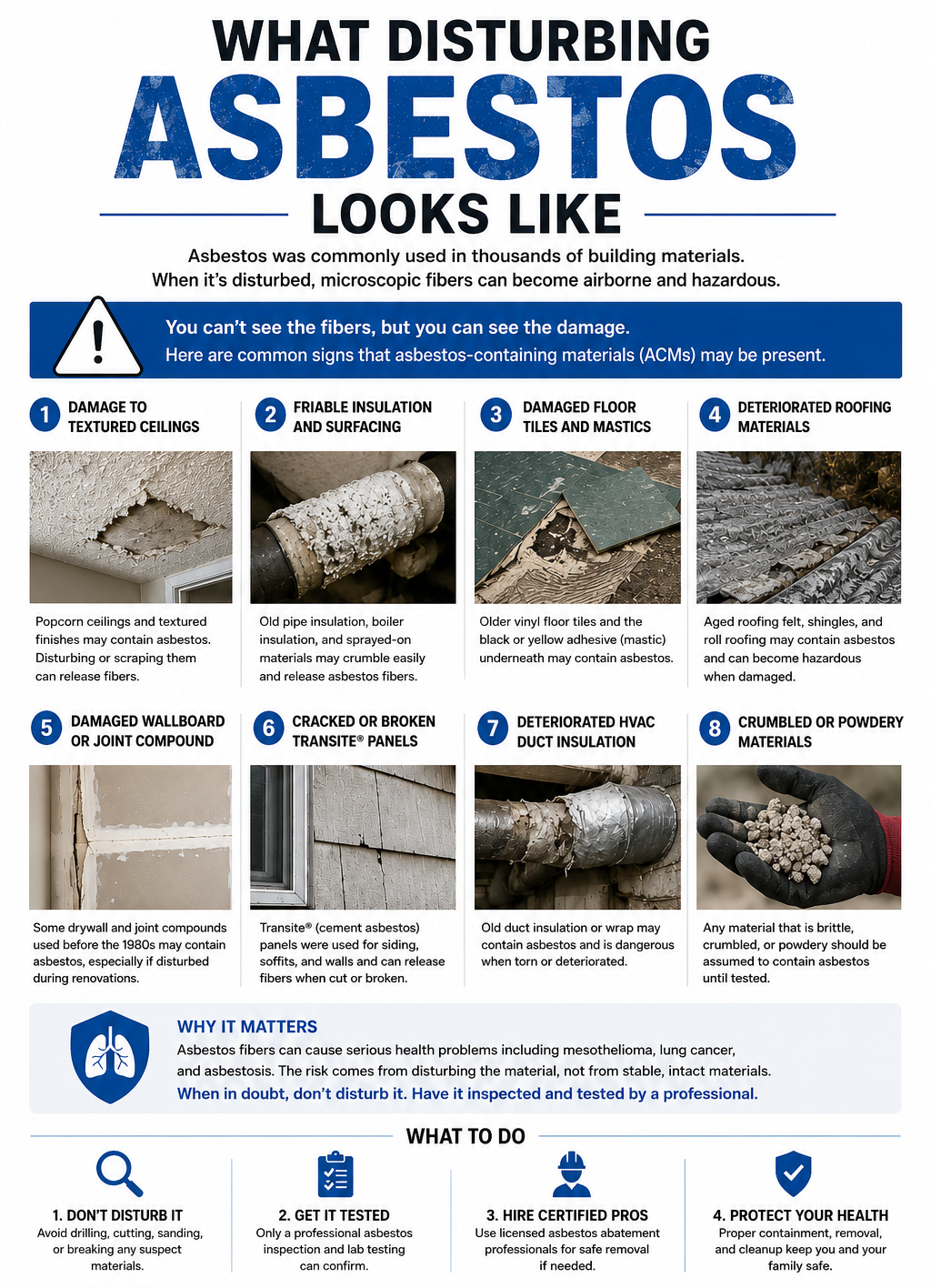
Las Vegas grew fast through the 1970s and 1980s, and a lot of the commercial stock from that era is still in active use — strip malls off Maryland Parkway, mid-rise offices downtown, older medical and dental suites, and garden-style apartment communities across Henderson and the east valley. Asbestos-containing materials (ACM) in these buildings tend to show up in predictable places:
- 9-inch and 12-inch vinyl floor tile and the black cutback mastic beneath it — extremely common in older retail and office space.
- Popcorn and other textured ceiling coatings in lobbies, corridors, and units.
- Drywall joint compound and skim coats — often the surprise item, because the whole wall assembly becomes regulated.
- Thermal system insulation on pipes, boilers, and mechanical-room fittings.
- Roofing felts, mastics, and flashing — a frequent trigger on commercial re-roofs.
- Transite panels, HVAC duct wrap, and fireproofing in mechanical and structural areas.
Intact, undisturbed ACM is generally left in place and managed. The regulatory and safety picture changes the moment that material is cut, drilled, demolished, or damaged by water — which is exactly why tenant improvements and leak repairs are the two most common reasons a property manager ends up needing abatement.

Testing comes first — and it’s not done by the abatement crew
Here’s the part that matters most for compliance, and the part property managers most often get wrong: the company that removes the asbestos is not the company that tests for it. Testing and sampling are performed by an independent accredited inspector who collects bulk samples and sends them to an accredited lab. That separation isn’t a formality — it keeps the scope honest and gives owners, lenders, and regulators a result that isn’t produced by the party being paid to do the removal.
At Pinpoint, we don’t test. For any pre-1988 property in Clark County, we connect you with an accredited inspector for the required survey, and once the lab confirms what’s present and where, we build the abatement scope around those results. If the survey comes back negative, you’ve spent a little on peace of mind and can proceed with your renovation. If it comes back positive, you now have the map you need to plan the work correctly.
Skipping the survey to “save time” is the single most expensive mistake in this process. Demolishing a wall with asbestos joint compound, or grinding into asbestos floor tile, can turn a scheduled $8,000 abatement into a contaminated-building emergency, a stop-work order, and a much larger cleanup. Test first — every time.
EPA NESHAP notification: the 10-day rule that trips people up
Commercial and multi-unit buildings fall under the federal EPA NESHAP (National Emission Standards for Hazardous Air Pollutants) asbestos rule, which is administered locally by the Clark County Department of Environment and Sustainability (DES). For most regulated renovation or demolition work involving asbestos, a written notification must be filed — and there’s a waiting period built in.
The rule most property managers run into: for a regulated job, notice generally must be submitted at least 10 working days before abatement or demolition begins. That’s not 10 calendar days, and it’s not something you can waive because the tenant improvement contractor is already on-site. If your renovation schedule doesn’t account for the notification window, your project stalls before it starts.
NESHAP also governs how regulated material is wetted, removed, bagged, labeled, and disposed of at a licensed landfill, with waste manifests documenting the chain of custody. A qualified abatement contractor handles the notification and the disposal paperwork as part of the job — but as the property manager, you should confirm it’s being filed and keep a copy. When you engage asbestos removal for a commercial property, ask to see the notification and the projected start date up front so it maps to your tenant and construction timeline.
“From the field: The projects that go sideways almost always trace back to the calendar, not the crew. A GC calls us Thursday wanting tile out for flooring installers on Monday, and the NESHAP clock alone makes that impossible. When property managers loop us in during planning — even before the survey — we can file notification, sequence the phases, and hit the actual construction date. The ten-day window is the easiest thing in this whole process to plan around, and the hardest to recover from once it’s missed.” — Pinpoint Property Services abatement team
Abating an occupied building: phased containment & after-hours work
The biggest difference between a residential and a commercial job is that you usually can’t empty the building. Tenants are paying rent, medical practices are seeing patients, and retailers are open. Commercial abatement is built around keeping the rest of the property functioning while one area is worked. Two tools make that possible:
Phased containment. Instead of treating the whole building as one project, the work is broken into contained zones — a single suite, one floor, one wing, or one mechanical room at a time. Each work area gets sealed off with critical barriers and polyethylene sheeting, run under negative air pressure using HEPA-filtered air scrubbers so nothing migrates out, and accessed through a decontamination unit. Adjacent tenants stay open because the contamination is physically and mechanically isolated from their space.
After-hours and off-shift scheduling. For retail centers, offices, and medical suites, a lot of commercial abatement happens nights and weekends. The crew mobilizes after the last tenant leaves, works inside sealed containment overnight, passes air clearance, and breaks down before the building reopens. It costs more in labor, but for a busy property it’s often cheaper than the lost revenue and tenant friction of a daytime shutdown.
Throughout the work, air monitoring runs during abatement, and a third-party lab performs the final clearance sampling before any containment is removed. That sequence — contain, remove under negative air, monitor, clear, then dismantle — is what lets a building stay open around an active asbestos project without putting occupants at risk.
Communicating with tenants and occupants
Nothing turns a routine abatement into a crisis faster than a tenant who sees plastic sheeting and respirators with no warning. As a property manager, your communication is as important as the technical work. A few practices keep it calm:
- Notify in writing, ahead of time. Give affected tenants a clear heads-up: what’s being done, which area, the dates and hours, and that the work is contained and cleared by an independent lab before anyone re-enters.
- Lead with the containment, not the hazard. Explain that the material is being professionally removed under sealed, negative-air containment specifically so the rest of the building stays safe — this is a safety upgrade, not an exposure event.
- Give a single point of contact. Tenants should know exactly who to call with questions. One informed contact beats a rumor spreading through a tenant email chain.
- Confirm re-occupancy in writing. When the area passes clearance, tell tenants the space has been cleared by an accredited third-party lab and is ready for normal use.
Warm, specific, factual communication does more to prevent panic than any amount of reassurance after the fact. We’re glad to help you draft occupant notices that say enough to inform without alarming.
Minimizing downtime and keeping the property operating
Downtime is where abatement quietly costs you the most, and most of it is avoidable with sequencing. The levers that keep a commercial property running:
- Sequence around the survey. Once the independent inspector’s results are in, phases can be ordered so the highest-traffic areas are worked during the lowest-traffic hours.
- Bundle abatement with the renovation timeline. Coordinating abatement, NESHAP notification, and the incoming trades in one schedule avoids the dead time of a crew waiting on a clearance that was never scheduled.
- Isolate building systems. Shared HVAC returns can carry air between suites, so isolating the mechanical system for the contained zone protects neighboring tenants and prevents a shutdown of the whole floor.
- Plan for water-triggered jobs. When a leak damages asbestos ceiling texture or floor tile, the abatement and the water damage restoration have to be coordinated so drying, removal, and rebuild don’t stall on each other.
The goal is straightforward: one contained area down at a time, the rest of the building open, and a schedule the incoming trades can actually build against.
Clearance documentation for owners and lenders
For a commercial property, the finished job isn’t “the material is gone” — it’s “here is the paperwork that proves it was done to standard.” That documentation package is what owners, lenders, buyers, and insurance carriers actually rely on, and it’s what protects you if the work is ever questioned. A complete package includes:
- The independent inspector’s survey and lab results that scoped the job.
- The EPA NESHAP notification filed with Clark County DES.
- Air monitoring results from during the abatement.
- Waste disposal manifests showing the material went to a licensed landfill.
- The final third-party clearance report confirming the area passed and is cleared for re-occupancy.
Lenders financing a building, buyers in due diligence, and owners of a portfolio all want these records standardized and retrievable — not scattered across three contractors’ emails. On our own abatement jobs, Pinpoint provides air monitoring and clearance documentation formatted for insurance carriers, real estate transactions, and regulatory records, and we can build standardized compliance packages for property managers running multiple buildings. When you’re ready to scope a project, contact us and we’ll walk the property with you.
What drives the cost of a commercial job
Every building is different, so there’s no flat rate — but the cost drivers are consistent. The material type and how friable it is, the square footage, how accessible it is, whether the building is occupied, and whether you need after-hours work all move the number. Below are realistic planning ranges for commercial asbestos work in the Las Vegas Valley to help you budget before the survey comes back.
| Scope / Item | Typical Las Vegas Range | Notes |
|---|---|---|
| Independent survey & lab testing (3rd party) | $450 – $1,500+ | Billed by the inspector, not the abatement contractor; scales with building size |
| Floor tile & mastic removal (per sq ft) | $8 – $18 / sq ft | Non-friable; lower end for open, accessible areas |
| Popcorn / textured ceiling abatement (per sq ft) | $5 – $15 / sq ft | Requires full containment and negative air |
| Pipe / thermal system insulation removal | $15 – $40 / linear ft | Friable material; higher cost and stricter controls |
| Small commercial suite abatement (project) | $4,000 – $15,000+ | Varies with material mix, containment, and occupancy |
| After-hours / weekend labor premium | +15% – 40% | Often cheaper than daytime tenant downtime |
These are planning ranges to help you budget — not a quote. Actual pricing depends on the independent lab results, material type and friability, square footage, accessibility, occupancy, and disposal requirements for your specific building. Every Pinpoint commercial job starts with a free on-site assessment and a written scope of work.
Frequently asked questions
Does Pinpoint test for asbestos before abatement?
No. Asbestos testing and sampling are performed by an independent accredited inspector and an accredited lab — never by the abatement contractor. This separation keeps the results objective for owners, lenders, and regulators. For any pre-1988 Clark County property, Pinpoint connects you with an accredited inspector for the required survey, then scopes the EPA NESHAP-compliant abatement around those lab results.
Can we keep our building open during commercial asbestos abatement?
In most cases, yes. Commercial abatement uses phased containment — sealing off one suite, floor, or mechanical room at a time under negative air pressure with HEPA filtration — so the rest of the property keeps operating. Many retail, office, and medical jobs are also scheduled after hours or on weekends, with the area cleared by an independent lab before it reopens.
How far in advance do we need to schedule a commercial abatement job?
Plan for the EPA NESHAP notification window: regulated commercial jobs generally require written notice to Clark County DES at least 10 working days before work begins. Add time for the independent survey beforehand. The earlier you loop in your abatement contractor — ideally during renovation planning — the more smoothly the notification, phasing, and construction timeline line up.
What documentation do owners and lenders expect after abatement?
A complete package includes the independent inspector’s survey and lab results, the EPA NESHAP notification, air monitoring results from during the work, waste disposal manifests, and the final third-party clearance report confirming the area passed. Pinpoint provides air monitoring and clearance documentation on our own jobs, formatted for insurance carriers, real estate transactions, and regulatory records.
What triggers the need for abatement in an older commercial building?
The two most common triggers in the Vegas Valley are tenant improvements or renovations that disturb asbestos-containing materials, and water damage that saturates asbestos ceiling texture, floor tile, or pipe insulation. Intact, undisturbed material is usually managed in place; abatement becomes necessary when that material is cut, demolished, or damaged.
How much does commercial asbestos abatement cost in Las Vegas?
It varies by material type and friability, square footage, accessibility, occupancy, and whether after-hours work is needed. As planning ranges, floor tile and mastic removal often runs $8–$18 per square foot, textured ceilings $5–$15 per square foot, and pipe insulation $15–$40 per linear foot, with after-hours labor adding a premium. Every Pinpoint commercial job starts with a free on-site assessment and a written estimate.
LOCAL. CERTIFIED. READY TO HELP.
Need Property Restoration or Cleanup in the Las Vegas Valley?
Whether it’s water damage, mold, asbestos, fire and smoke, or a biohazard situation, Pinpoint Property Services can help you understand the next step.
Contact Pinpoint Property Services Today for a Free Inspection:

