
Asbestos Test Before You Remodel: What Las Vegas Homeowners Need to Know
You are planning the fun part — new countertops, an opened-up floor plan, finally scraping that popcorn ceiling. Before the first wall comes down, there is one question worth answering: was the home built before about 1980, and could the materials you are about to disturb contain asbestos?
If the answer is “maybe,” a test comes first. Asbestos is only hazardous when it is disturbed, and a remodel disturbs exactly the materials most likely to contain it. This guide covers when a test is required in Clark County, who does the testing versus the removal, what it costs in the Vegas Valley, and how to keep a positive result from derailing your project.
Quick Facts
Short answer: If your Las Vegas or Henderson home predates about 1980 and the remodel will disturb suspect materials, yes — test before you start.
Who tests: An independent, accredited asbestos inspector collects samples and an accredited lab analyzes them. Pinpoint does not test in-house — an independent result keeps it unbiased.
Who removes: If a sample comes back positive, a licensed abatement contractor (that is us — Nevada license #0084981) removes and disposes of it under EPA NESHAP standards.
Local rule: Clark County generally requires accredited testing before renovation or demolition that disturbs pre-1980 materials.
Bottom line: Testing upfront is far cheaper than a mid-project shutdown — or a home-wide decontamination.
In This Guide
- Why a Pre-1980 Home Needs a Test Before You Remodel
- Who Tests, Who Removes — and Why We Keep Them Separate
- When an Asbestos Test Is Required
- What to Expect From the Inspection
- What Testing and Removal Cost in the Vegas Valley
- After the Results: Your Next Move
- Pinpoint Field Note
- Frequently Asked Questions
Why a pre-1980 home needs a test before you remodel
For decades, asbestos was a standard ingredient in building products because it resists heat and fire and adds durability. In Las Vegas Valley homes built before the early 1980s, it turns up in a surprising number of places — and a remodel tends to disturb exactly those places.
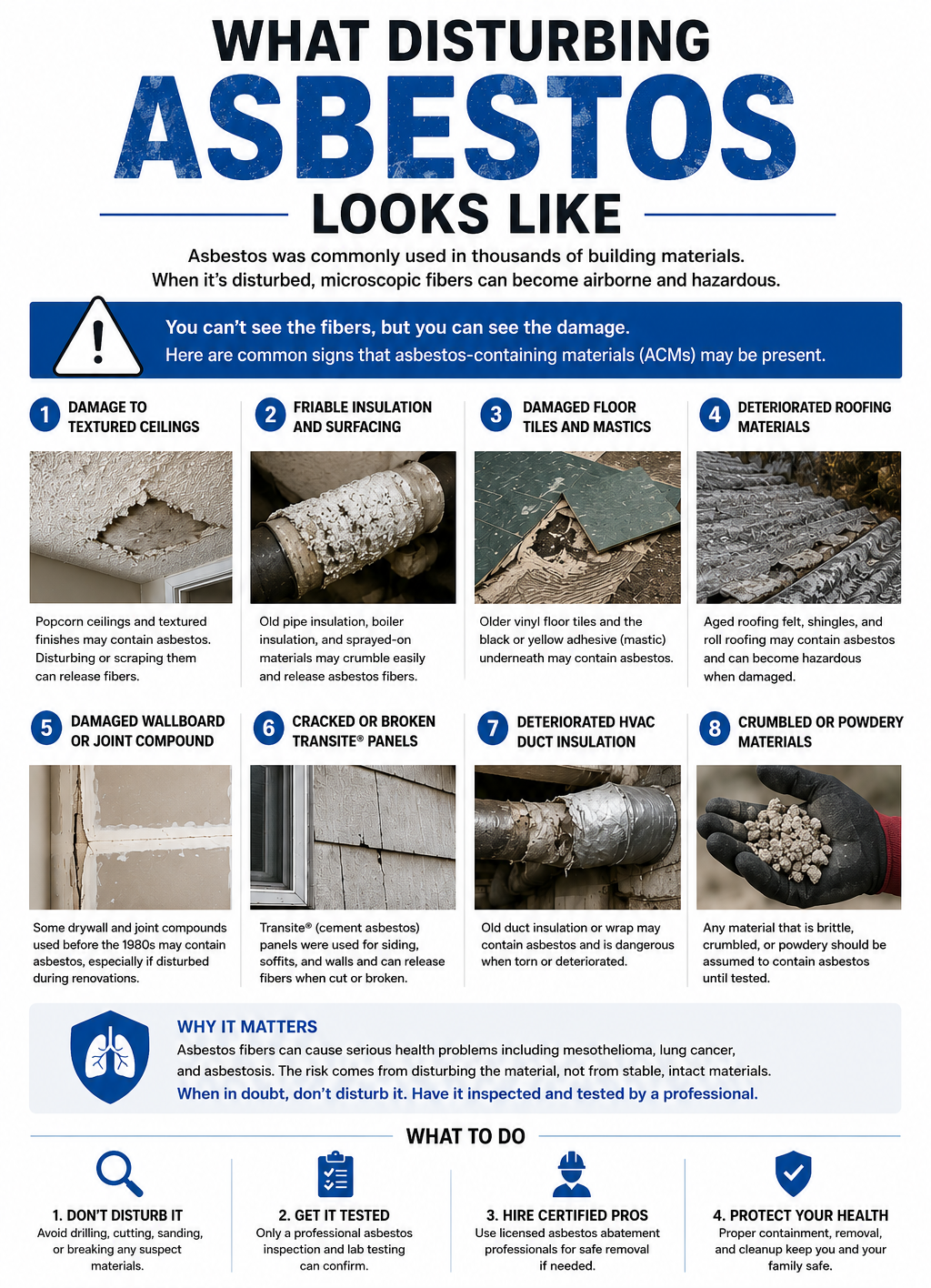
Common materials in older Vegas homes that may contain asbestos:
- Textured ceilings: The “popcorn” or “cottage cheese” finish, and some acoustic coatings.
- Flooring: Vinyl tiles and the black mastic adhesive beneath them.
- Drywall: Joint compound used to finish seams and corners.
- Insulation: Pipe wrap, boiler insulation, and attic insulation.
- Roofing and siding: Some older exterior products.
Intact and undisturbed, these materials are generally safe. The danger begins the moment they are cut, sanded, drilled, or torn out, which releases microscopic fibers into the air. Inhaled over time, those fibers are linked to serious lung disease, and there is no established safe level of exposure. That is why the safest move is to identify suspect materials before any work that might disturb them — the U.S. EPA advises against disturbing suspect materials without professional guidance.
If popcorn ceilings are part of your project, our homeowner’s guide to popcorn ceilings and asbestos walks through that material specifically.
Who tests, who removes — and why we keep them separate
This trips up a lot of homeowners, so it is worth being clear: testing and removal are two different jobs done by two different parties, on purpose.
Testing is done by an independent, accredited inspector. They walk the areas you plan to renovate, identify suspect materials, carefully collect small samples, and send them to an accredited laboratory for analysis. The lab confirms whether asbestos is present, what type, and at what concentration. Pinpoint does not perform this testing in-house, and that is deliberate — an independent lab has no incentive to find a problem that is not there. Need an inspector? Call us and we will refer you to a trusted accredited tester.
Removal is done by a licensed abatement contractor. If the lab result is positive and the material needs to come out before your remodel, that is our lane. Pinpoint is a licensed Nevada abatement contractor (license #0084981) and we contain, remove, and dispose of asbestos-containing materials under EPA NESHAP standards. The only testing-type work we perform is air monitoring during our own abatement and clearance confirmation on our own jobs — never the upfront diagnostic sampling that tells you whether you have a problem.
Keeping the inspector separate from the abatement contractor protects you: the party telling you whether you have asbestos has no stake in selling you the removal.
When an asbestos test is required before remodeling
Federal rules from the EPA set the baseline for handling asbestos during demolition and renovation, and Nevada and Clark County take them seriously. If your home was built before 1980 and your plans will disturb suspect materials — textured ceilings, old flooring, insulation, drywall compound — an accredited survey is generally expected before work begins.
Residential versus commercial
The strictest, most explicit requirements under the EPA’s National Emission Standards for Hazardous Air Pollutants (NESHAP) target commercial, institutional, and industrial buildings. For a single-family home, a small cosmetic update may not trigger a hard mandate, but a larger renovation or demolition often does — and many reputable contractors will not touch a pre-1980 home without documented testing, because the liability and the health risk fall on everyone. The Clark County Division of Air Quality publishes the current asbestos requirements and forms.
What non-compliance costs
Skipping required testing can mean significant fines, a forced stop-work order mid-project, and real liability if someone is later exposed. A test done upfront is the cheapest insurance against all three.
What to expect from the inspection
When you bring in an accredited inspector, the visit is methodical and low-disruption. Here is the typical sequence.
The walkthrough and sampling
The inspector walks the areas you plan to renovate and flags anything suspect — popcorn texture, vinyl flooring, drywall compound, pipe wrap, certain insulation. Small samples are collected using wet methods and containment so fibers are not released, and each sample is labeled by location, material, and condition. This is precisely the work you should never DIY: an untrained sample can spread the very fibers you are trying to avoid.
Lab analysis and turnaround
Samples go to an accredited lab, where each is analyzed under a microscope for asbestos content. Results typically come back in a few business days — sometimes within 24 hours on a rush.
| Material sampled | Common in pre-1980 homes | Typical lab turnaround |
|---|---|---|
| Popcorn ceiling texture | Yes | 2–5 days |
| Vinyl floor tile & mastic | Yes | 2–5 days |
| Pipe & attic insulation | Yes | 2–5 days |
Reading the results
The inspector’s report tells you which materials contain asbestos, where, and at what concentration — and whether they need removal or can be safely managed in place given their condition. Keep that documentation: it matters for your contractor’s safety planning and for any future sale of the home.
What testing and removal cost in the Vegas Valley
Cost is the question everyone asks, and the honest answer is that it depends on how many samples are needed and, if asbestos is found, how much material has to come out. The ranges below are typical Las Vegas Valley estimates to help you plan — they are not a quote, and the lab test is billed by the independent inspector, not by us.
| Step | Who performs it | Typical cost range |
|---|---|---|
| Pre-remodel asbestos survey | Independent accredited inspector | ~$250–$800 |
| Single bulk sample (lab analysis) | Independent accredited lab | ~$50–$125 each |
| Popcorn ceiling abatement — single room | Licensed abatement contractor | ~$1,000–$3,000 |
| Whole-home abatement | Licensed abatement contractor | ~$3,000–$15,000 |
Field Note: A survey is a few hundred dollars. A remodel that disturbs asbestos and spreads it through the HVAC system can turn into a five-figure decontamination. The test is the cheap part.
Pinpoint provides free estimates for removal and abatement once you have a positive result in hand.
After the results: your next move
If the result is negative
Clean report? Proceed with confidence. Your contractor can begin without the added containment and safety steps asbestos requires. Keep the report on file — it is useful documentation for a future renovation or sale.
If asbestos is found
Do not panic, and do not stop the remodel for good — this is exactly why you tested first. A positive result means a licensed abatement contractor removes the material before your renovation continues. Here is what that looks like on our jobs:
- Containment: The work area is sealed with heavy plastic sheeting and put under negative air pressure with HEPA filtration, so fibers cannot reach the rest of the home or the HVAC system.
- Wet removal: Technicians in protective gear wet the material to suppress fibers, then remove it carefully and seal it into labeled, heavy-duty bags.
- Disposal: Asbestos waste goes to a facility licensed to handle it — never the curb.
- Clearance: We monitor the air and confirm clearance before containment comes down, then hand you documentation of the completed abatement.

For more on how we handle confirmed asbestos, see our asbestos abatement process and our asbestos removal in Las Vegas service.

Pinpoint Field Note
Pinpoint Field Note
The remodels that go sideways almost always share one detail: the homeowner found out about asbestos after the demo, not before. By then a popcorn ceiling has been dry-scraped, the dust is in the return vents, and a one-room project has become a whole-home problem. The order that keeps these jobs small never changes — independent test first, abatement second, rebuild third.
The good news is that a positive result rarely kills a remodel. It just resequences it. Test early, build the abatement into the schedule, and the project moves forward on solid ground instead of stopping cold halfway through.
— Pinpoint Property Services, Field Observation
Frequently asked questions
Do I really need an asbestos test before remodeling my Las Vegas house?
If your home was built before about 1980 and the remodel will disturb suspect materials like popcorn ceilings, old flooring, or insulation, then yes. Disturbing those materials can release fibers into the air, and testing first is the only reliable way to know whether you are dealing with asbestos before any work begins.
Which materials in my home might contain asbestos?
Common culprits in pre-1980 homes include textured “popcorn” ceilings and acoustic coatings, old vinyl floor tile and its black mastic adhesive, drywall joint compound, pipe and attic insulation, and some older roofing and siding. It was used widely because it resists heat and fire.
Who actually does the asbestos testing?
An independent, accredited inspector collects the samples and an accredited lab analyzes them. Pinpoint does not test in-house on purpose, so the result stays unbiased. If the test comes back positive, that is when a licensed abatement contractor like Pinpoint removes the material.
Is it illegal to remodel without testing for asbestos in Las Vegas?
It can be. Federal, state, and local rules require proper testing and handling before certain renovation or demolition work, especially on pre-1980 properties. Skipping it can lead to fines and stop-work orders, so it is safest to confirm the requirements for your specific project with Clark County before you start.
Can I just collect the asbestos sample myself?
It is strongly discouraged. Asbestos fibers are microscopic and dangerous to inhale, and an untrained sample can release them and spread contamination. Leave sampling to an accredited inspector who uses wet methods and containment to do it safely.
How much does an asbestos test cost?
In the Las Vegas Valley a pre-remodel survey by an independent inspector typically runs about $250 to $800, with individual lab samples roughly $50 to $125 each. That is far less than the cost of stopping a project mid-demolition to deal with disturbed asbestos.
What happens if asbestos is found?
You bring in a licensed abatement contractor before the remodel continues. They seal off the area under negative air pressure, remove the material using wet methods, dispose of it at a licensed facility, and confirm clearance with air monitoring. Once the space is cleared, your renovation picks back up.
How long does the whole process take?
Sample collection usually takes an hour or two, and lab results commonly come back in two to five business days. If abatement is needed, the timeline depends on how much material is involved. Planning the test early in your renovation schedule keeps everything moving.
LOCAL. CERTIFIED. READY TO HELP.
Need Property Restoration or Cleanup in the Las Vegas Valley?
Whether it’s water damage, mold, asbestos, fire and smoke, or a biohazard situation, Pinpoint Property Services can help you understand the next step.
Contact Pinpoint Property Services Today for a Free Inspection:

