
Fire Damage Insurance Claims in Las Vegas: Partial vs. Total Loss
A kitchen fire in Summerlin, an electrical fault in a Henderson garage, a wildfire ember that finds its way onto a roof near the foothills — the flames are usually out within minutes. The insurance claim that follows can stretch on for months. And in the Vegas Valley, where dry desert air pushes smoke and soot deep into wall cavities and HVAC systems long after the fire is extinguished, the difference between a claim that pays fairly and one that leaves you short often comes down to one thing: documentation.
If your home or business has been damaged by fire, you are probably being asked to make decisions you have never faced before, while you are still shaken. This guide walks you through how a fire damage insurance claim actually works in Las Vegas — what a “partial loss” versus a “total loss” means for your payout, how actual cash value differs from replacement cost, what your adjuster is looking for, and where a documented scope of work protects you. We can’t promise what your carrier will approve; no honest contractor can. What we can do is help you go into the process informed, so nothing legitimate gets missed.
- Partial loss means the structure can be repaired and restored; total loss means rebuilding costs more than the property is worth to repair.
- ACV (actual cash value) pays depreciated value up front; RCV (replacement cost value) reimburses the rest once repairs are actually completed.
- Smoke and soot damage often extends far beyond the visibly burned area — a documented smoke-migration map is part of a complete claim.
- Nevada gives you a limited window to file and respond; check your policy’s proof-of-loss deadline early.
- You have the right to choose your own licensed restoration contractor — you are not required to use the carrier’s preferred vendor.
- Golden rule: document everything before anything is cleaned, moved, or thrown away. Photos and a written scope are your leverage.
- How a Fire Damage Insurance Claim Works
- Documentation: Photos, Contents Inventory & Smoke Mapping
- Partial Loss vs. Total Loss
- ACV vs. Replacement Cost: How You Actually Get Paid
- Working With the Adjuster
- Why a Documented Scope of Work Protects You
- Common Fire Claim Pitfalls
- How a Restoration Contractor Supports Your Claim
- Typical Fire Restoration Cost Ranges in Las Vegas
- Frequently Asked Questions
How a Fire Damage Insurance Claim Works
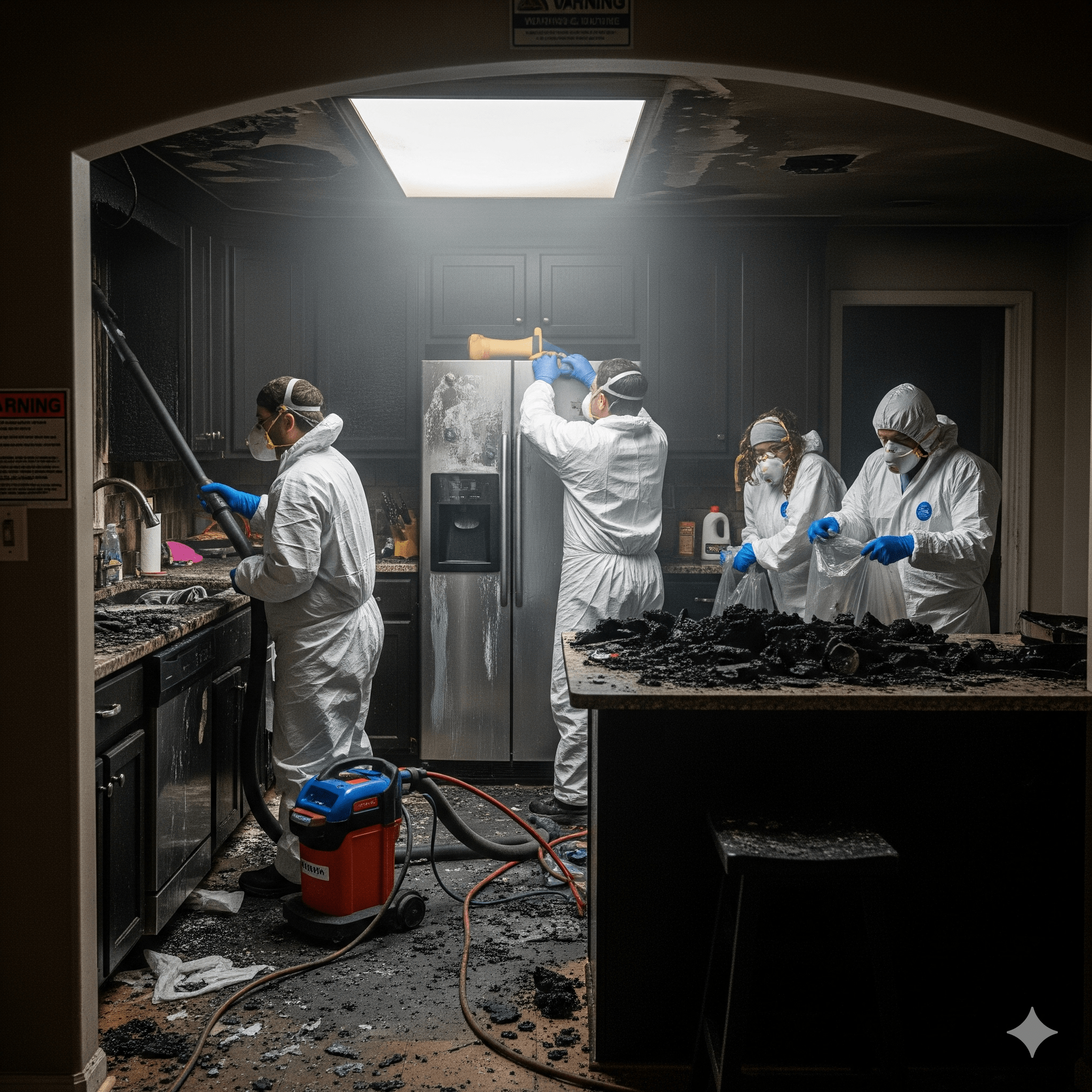
A fire claim moves through a predictable sequence, even when it doesn’t feel that way in the moment. First, you report the loss to your carrier and get a claim number — do this as soon as the property is safe to be near, because most policies have deadlines. Next, the insurer assigns an adjuster who inspects the damage, either in person or, increasingly, through photos and video. The adjuster estimates the cost to repair or replace what was lost, applies your deductible and any depreciation, and issues payment in one or more installments.
In parallel, emergency mitigation should begin quickly. Most policies require you to take “reasonable steps” to prevent further damage — boarding up, tarping a burned roof, extracting water left behind by the fire department, and containing soot before it spreads. In Las Vegas, that water-damage overlap is real: a fire response can leave hundreds of gallons behind, and our water damage crews often work the same loss as the fire cleanup. Skipping mitigation can actually reduce what a carrier pays, because they may argue the additional damage was preventable.
The claim isn’t settled when the first check arrives. Fire losses frequently involve supplements — additional damage discovered once demolition begins and hidden soot, charred framing, or compromised wiring comes to light. A thorough contractor documents those findings so they can be submitted, rather than absorbed by you.
Documentation: Photos, Contents Inventory & Smoke Mapping
Documentation is the single biggest lever you control in a fire claim. The adjuster can only pay for damage they can see and substantiate — so the more complete your record, the stronger your position. Before anyone cleans, moves, or discards anything, capture the loss in three layers:
Photos and video. Wide shots of each room for context, then close-ups of soot lines, char, heat-warped fixtures, melted outlets, and smoke staining. Photograph the ceiling and the top of walls — that’s where soot settles first. Date-stamp everything and keep the originals.
Contents inventory. A room-by-room list of damaged personal property: item, approximate age, brand or model where you know it, and a rough replacement cost. This is tedious, and it is also where a lot of claim value hides. Salvageable contents can often be cleaned through professional pack-out and ozone or hydroxyl treatment rather than replaced — but you need the list either way.
Smoke-migration mapping. This is the step homeowners most often miss. Smoke doesn’t respect the boundary of the burned room. In a dry Vegas Valley climate, soot particles travel through return-air ducts, gaps around outlets, and up into attic spaces, leaving odor and residue in rooms the flames never touched. Mapping that migration — with photos, moisture and residue readings, and HVAC inspection — is what justifies cleaning and deodorizing beyond the obvious fire zone. Without it, a carrier has no reason to pay for it.
Partial Loss vs. Total Loss
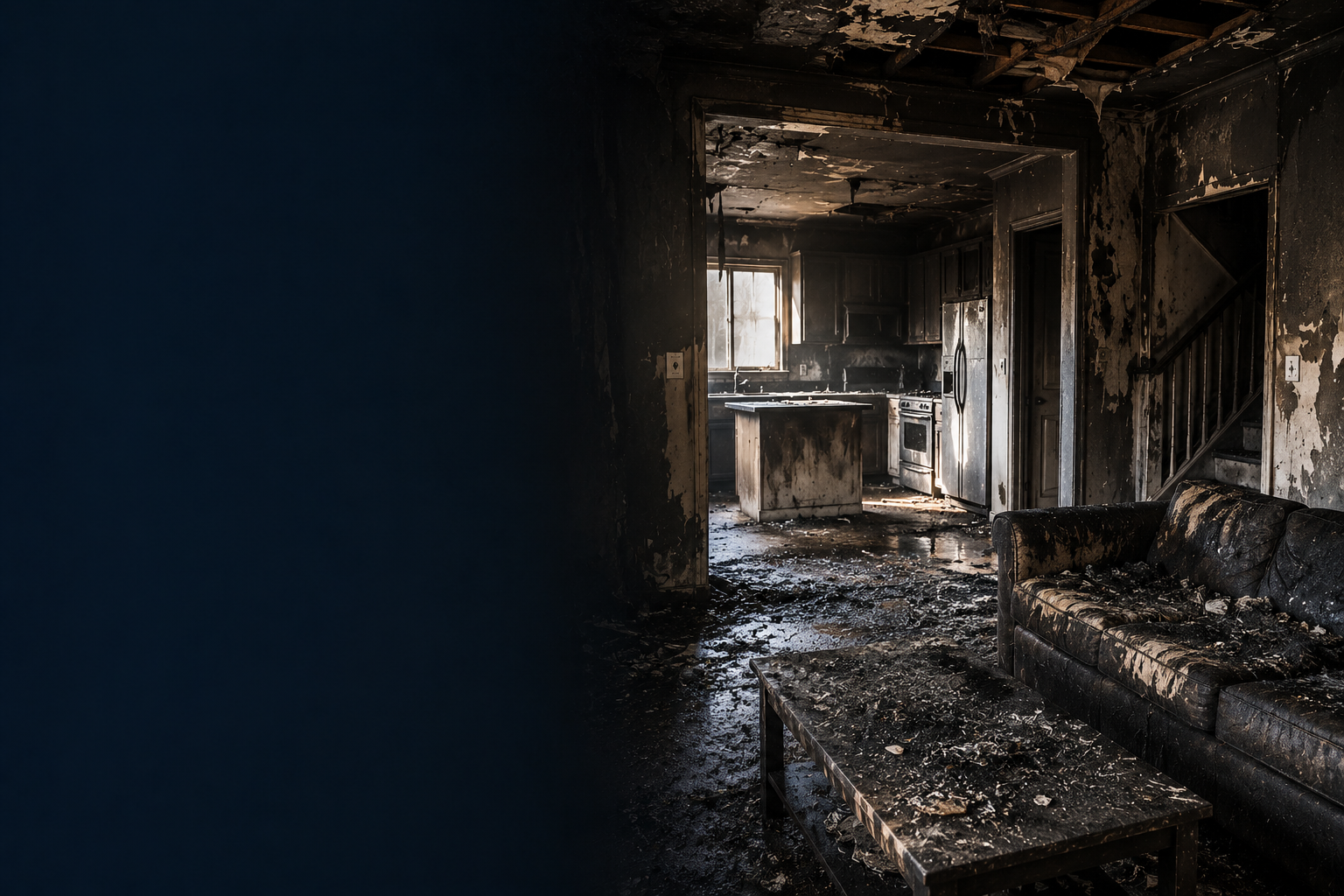
How your claim is classified shapes almost everything that follows. A partial loss means the structure is damaged but repairable — the framing, foundation, and much of the building are intact, and restoration returns the property to its pre-loss condition. Most residential fire claims in Las Vegas are partial losses, even when the damage looks devastating at first, because soot and smoke spread far more than fire consumes.
A total loss means repairing the property would cost as much as — or more than — its insured value, so the carrier pays out the policy limit (or the dwelling’s value) rather than rebuilding piece by piece. Total losses are less common but do happen, particularly with fast-moving fires or older structures.
Why the distinction matters to you: in a partial loss, the fight is usually about scope — how far the smoke traveled, how much has to be removed and rebuilt, whether that heirloom cabinetry can be restored. In a total loss, the fight is usually about value — whether the payout reflects what it truly costs to rebuild at today’s Las Vegas labor and material prices. Either way, documentation decides it. Under-documenting a partial loss is how homeowners end up paying out of pocket for soot damage that should have been covered.
ACV vs. Replacement Cost: How You Actually Get Paid
Two acronyms drive your payout, and confusing them costs people money.
Actual Cash Value (ACV) is the depreciated value of what was damaged — replacement cost minus wear and age. A ten-year-old roof isn’t reimbursed as a new roof under ACV; it’s reimbursed as a ten-year-old roof. Carriers typically issue the ACV amount first.
Replacement Cost Value (RCV) is what it actually costs to replace the item new, with no depreciation deducted. If your policy is a replacement-cost policy, you recover the withheld depreciation — the gap between ACV and RCV — but usually only after the work is completed and you submit proof. That “recoverable depreciation” is real money you leave on the table if you settle for the ACV check and never finish documented repairs.
The practical takeaway: read your declarations page to learn whether you carry ACV or RCV coverage, and if it’s RCV, keep every invoice and completion record so you can recover the held-back depreciation. A restoration contractor’s itemized scope and final invoice are exactly the paperwork carriers require to release those funds.
Working With the Adjuster
Your adjuster is not your adversary, but they do work for the insurer, and their estimate reflects what the carrier believes it owes. You can make that process go smoothly and thoroughly at the same time:
- Be present for the inspection — or have your restoration contractor there — so nothing gets overlooked and questions get answered on the spot.
- Share your documentation early. The photos, inventory, and smoke map give the adjuster a reason to write a broader scope rather than a narrow one.
- Get the estimate in writing and read it line by line. Compare it against your contractor’s scope. Gaps — missing rooms, no deodorization, no HVAC cleaning — are normal on a first pass and are addressed through supplements.
- Keep a claim log. Note every call, name, and date. If the claim drags, that record matters.
If your contractor’s documented scope and the adjuster’s estimate differ significantly, that’s not a dead end — it’s the start of a supplement conversation backed by evidence. In Nevada, you also have the right to dispute a settlement you believe is incomplete.
Why a Documented Scope of Work Protects You
A scope of work is the detailed, line-item plan for restoring your property: every affected area, every task, the materials, and the reasoning behind each one. It is the document that turns “there’s fire damage” into “here is precisely what it takes to make this right, and why.” That specificity is your protection.
A vague estimate invites a vague settlement. A detailed scope — grounded in recognized standards like the IICRC S500 for water and S700 for fire and smoke restoration — gives the adjuster line items to approve and gives you a record to hold the carrier to. It also protects you on the back end: if hidden damage surfaces during demolition, a documented baseline scope makes the supplement a straightforward addition rather than an argument from scratch.
Just as importantly, a documented scope keeps you from being under-restored. It’s one thing to paint over a soot-stained wall; it’s another to seal and properly deodorize so the smoke odor doesn’t return the first hot Las Vegas afternoon when the HVAC kicks on. The scope is where that distinction gets written down and paid for.
Common Fire Claim Pitfalls
The same mistakes cost Vegas Valley homeowners money again and again:
- Cleaning or throwing things out too soon. Discarded items and scrubbed surfaces are damage you can no longer prove. Document first, always.
- Settling for the ACV check. If you have RCV coverage and never complete or document repairs, you forfeit the recoverable depreciation.
- Ignoring smoke migration. Repairing only the burned room leaves soot and odor in the rest of the house — a problem that resurfaces months later, after the claim is closed.
- Missing deadlines. Reporting late or blowing past the proof-of-loss window can jeopardize the whole claim.
- Skipping mitigation. Failing to prevent further damage can reduce what the carrier owes.
- No itemized scope. A one-line estimate leaves money on the table and gives you nothing to enforce.
From the Field: On a garage fire off Eastern Avenue, the visible burn was contained to one wall — but our residue readings showed soot had pulled through the return air and settled across two bedrooms on the far side of the house. The homeowner’s first instinct was to just repaint the garage. Because we mapped and photographed the migration before touching anything, that whole-home cleaning and deodorization went into the documented scope and was approved. Skip that step and it becomes the odor that “mysteriously” comes back in July.
How a Restoration Contractor Supports Your Claim
A licensed restoration contractor does more than clean up — a good one becomes the documentation engine behind your claim. At Pinpoint Property Services, our fire damage cleanup crews photograph and map the loss before work begins, build an itemized scope tied to industry standards, meet the adjuster on-site, and produce the invoices and completion records carriers require to release recoverable depreciation. We handle the soot, smoke, structural drying, and deodorization — and we keep the paper trail that keeps your claim honest.
We’re a Nevada-licensed company (License #0084981) based at 6210 Annie Oakley Drive, and we work fire losses across Las Vegas, Henderson, and the surrounding valley. We can’t and won’t promise what your insurer will approve — that decision is theirs. What we can promise is that nothing legitimate goes undocumented on our watch. That’s what “Precise Solutions. Clean Results.” means when the stakes are your home and your claim. If you’re navigating a fire loss right now, contact us and we’ll walk you through the next step.
Typical Fire Restoration Cost Ranges in Las Vegas
Every fire loss is different, but these planning ranges reflect what Vegas Valley homeowners commonly see for the restoration work behind a claim:
| Scope of Work | Typical Las Vegas Range |
|---|---|
| Emergency board-up & roof tarping | $500 – $2,500 |
| Soot & smoke cleaning (single room) | $1,500 – $5,000 |
| Whole-home deodorization & HVAC cleaning | $3,000 – $8,000 |
| Contents pack-out, cleaning & storage | $2,000 – $10,000+ |
| Structural repair / partial rebuild | $10,000 – $75,000+ |
These are planning ranges to help you understand scale, not a quote. Actual pricing depends on the size of the loss, materials, and the documented scope — and most of it is billed to your claim, not to you, beyond your deductible. Ask for an itemized estimate for your specific property.
Frequently Asked Questions
Do I have to use the restoration company my insurance recommends?
No. You have the right to choose your own licensed restoration contractor in Nevada. Carriers may suggest a preferred vendor, but the decision is yours — and choosing a contractor who documents thoroughly can strengthen your claim.
What’s the difference between ACV and replacement cost on my fire claim?
Actual Cash Value (ACV) pays the depreciated value of damaged property and is usually issued first. Replacement Cost Value (RCV) reimburses the full cost to replace items new, but the withheld “recoverable depreciation” is typically released only after documented repairs are completed. Check your declarations page to see which coverage you carry.
How is a partial loss different from a total loss?
A partial loss means the structure is repairable and restoration returns it to pre-loss condition — most residential fire claims are partial losses. A total loss means repair would cost as much as or more than the property’s insured value, so the carrier pays the policy limit instead of rebuilding.
Why does smoke damage matter if the fire was small?
Smoke and soot travel far beyond the burned area, especially through HVAC ducts and wall cavities in the dry Vegas Valley climate. Untreated, they leave odor and residue in rooms the fire never reached — often resurfacing months later. Mapping and documenting that migration is what justifies cleaning and deodorization beyond the obvious fire zone.
Can you promise my fire claim will be approved?
No honest contractor can promise coverage or approval — that decision belongs to your insurer and depends on your policy. What a good restoration contractor can do is document the loss thoroughly and build an itemized, standards-based scope so nothing legitimate is overlooked in the claim.
What should I do first after a fire in my Las Vegas home?
Once the property is safe to approach, report the loss to your carrier to get a claim number, then document everything with photos and video before cleaning or discarding anything. Begin emergency mitigation — board-up, tarping, water extraction — to prevent further damage, and bring in a licensed restoration contractor to map the damage and build your scope.
LOCAL. CERTIFIED. READY TO HELP.
Need Property Restoration or Cleanup in the Las Vegas Valley?
Whether it’s water damage, mold, asbestos, fire and smoke, or a biohazard situation, Pinpoint Property Services can help you understand the next step.
Contact Pinpoint Property Services Today for a Free Inspection:

