
Garage Fire Smoke Damage: Why It Spreads Into the House
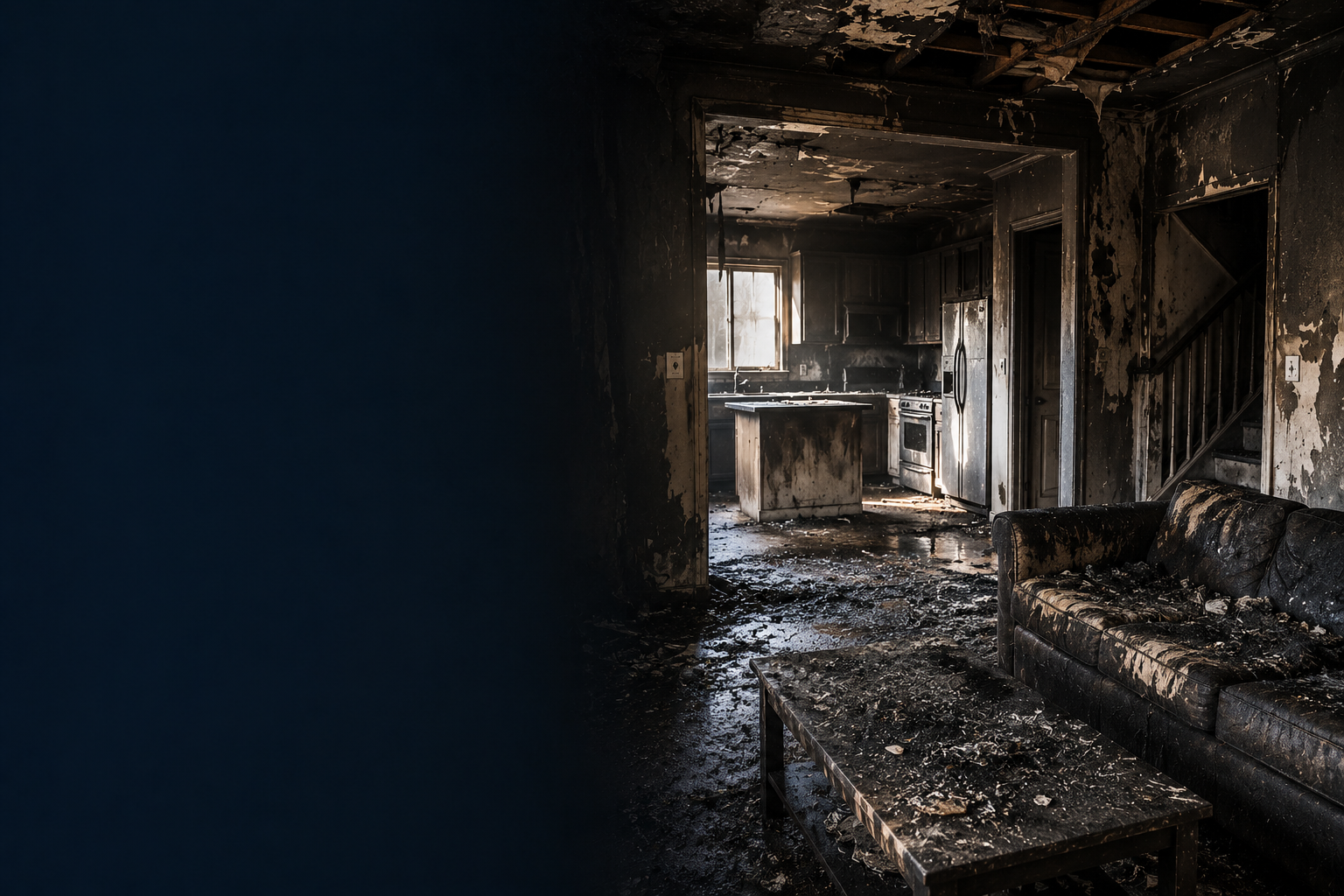
The fire started in the garage — a charger left plugged in, an oily rag, a spark near the water heater, a lithium battery that went into thermal runaway. The flames may have stayed on that side of the wall. The smoke did not. By the time the fire department clears the scene, a haze has already worked its way under the door to the kitchen, into the hall closet, and up into the attic, and the whole house smells like a burnt tire fire that won’t quit.
That’s the part that catches Las Vegas homeowners off guard. A garage isn’t a spare bedroom — it’s a chemical storage locker attached to your living space. Paint, gasoline, motor oil, pesticides, pool chemicals, propane, spare tires, and stacks of plastic bins all burn at once, and they throw off a dense, oily, toxic smoke that behaves nothing like a clean wood fire. In our tightly sealed, air-conditioned Valley homes, that smoke finds every gap between the garage and the living space and pushes through it.
This guide explains why garage fires produce such stubborn, greasy smoke, exactly how it migrates into your living space through the attic, shared walls, and the HVAC, why the odor is so hard to kill, and what a real containment, cleaning, and deodorization process looks like — plus honest Las Vegas cost ranges so you know what you’re walking into.
- Garage smoke is chemically dirtier than house smoke. Burning fuel, paint, plastics, and tires produce an oily, sooty film that clings and stinks far worse than wood smoke.
- The wall between garage and house is not airtight. Smoke migrates through the attic, wire and pipe penetrations, the door gap, and shared cavities into every room.
- Your A/C makes it worse. A running HVAC pulls smoke through the returns and blows odor into rooms the fire never reached.
- Odor hides in porous materials — drywall, insulation, framing, stored contents — so wiping surfaces alone will never fully clear the smell.
- Golden rule: Don’t run the A/C, don’t start wiping, and don’t throw anything out — photograph everything and call a restoration pro before you touch a surface.

- Why garage smoke is so oily and toxic
- How garage smoke migrates into the house
- How your HVAC spreads it room to room
- Why the odor is so stubborn
- The containment and cleaning process, step by step
- Deodorization: source first, then hydroxyl
- Contents and vehicle considerations
- What garage fire smoke cleanup costs in Las Vegas
- Frequently asked questions
Why garage smoke is so oily and toxic
What makes a garage fire different isn’t the flame — it’s the fuel. A living room fire mostly burns wood, paper, and upholstery. A garage burns the things you deliberately don’t store inside the house: half-full cans of paint and solvent, gasoline in the mower and spare cans, motor oil, brake cleaner, pesticides and fertilizer, pool chlorine, propane cylinders, spare tires, and shelves of plastic totes. When those ignite together, they release a thick, black, greasy smoke loaded with unburned hydrocarbons, soot, and a stew of chemical compounds.
That smoke leaves a very different residue than a clean fire. Burning plastics and petroleum products produce a wet, oily, sticky film that bonds to whatever it lands on and carries an acrid, rubbery, chemical odor that’s dramatically harder to remove than the dry, powdery soot of a wood fire. Burning tires alone are notorious for a jet-black oily deposit that smears the moment you touch it. And synthetic materials release corrosive byproducts — the residue is slightly acidic, so the longer it sits, the more it etches glass, pits metal, discolors finishes, and yellows plastics.
There’s a health dimension too. This is soot you don’t want to breathe or spread around your home — which is exactly why disturbing it with a rag or a shop vac, instead of containing and HEPA-filtering it, tends to make a bad situation worse.
How garage smoke migrates into the house
Homeowners assume the wall between the garage and the house holds the smoke back. It doesn’t. Building code requires that wall to resist flame for a period of time, but smoke is a gas under pressure, and it exploits every path that fire-rated drywall doesn’t seal. In a typical attached Las Vegas home, smoke travels into the living space through several routes at once:
- The attic. This is the big one. The garage ceiling and the house share a connected attic space in many homes, and heat drives smoke straight up through recessed lights, the attic hatch, and gaps around the top plates. Once it’s in the attic, it settles into the insulation above your bedrooms and re-releases odor for weeks.
- Shared walls and cavities. Smoke pushes through electrical outlets, switch boxes, and the penetrations where wires and pipes pass from the garage into the house. Every one of those holes is a smoke channel.
- The door to the house. The gap under the door, the sides, and the frame let a visible haze roll directly into the kitchen or hallway — often the first place the family notices the smell.
- The HVAC. If the system was running, it did the work for the smoke (more on that below).
Because the smoke arrives through so many hidden paths, the odor shows up in rooms that never saw flame — and cleaning only the garage leaves the source in the attic and wall cavities untouched. A real assessment traces the smoke, not just the fire.
How your HVAC spreads it room to room
In Las Vegas we run the air conditioning nearly year-round, and that habit turns a contained garage fire into a whole-house problem. If the HVAC was running during or after the fire — or if someone switched it on to “clear the air” — the return vents pulled smoke into the system and the blower distributed it through the ductwork to every room the system feeds. Now there’s oily residue on the inside of the ducts, on the coil, and on the registers, and every time the A/C cycles it re-deposits smoke odor into your bedrooms.
This is why a garage fire assessment doesn’t stop at the garage. We check returns and supply registers for residue, evaluate whether the ducts need cleaning, and often recommend replacing the filter and cleaning the coil and blower. Skip it and you’ll chase a phantom smell for months. Turning the system off and leaving it off until it’s been inspected is one of the most valuable things you can do before help arrives — it stops the smoke from spreading any further than it already has.
Why the odor is so stubborn
Garage-fire odor outlasts almost every other kind of smoke smell, and there are concrete reasons why. First, the smoke itself is heavier and oilier, so the residue that carries the smell bonds harder to surfaces and soaks deeper into porous materials. Second, garages are full of the most odor-absorbent materials in the house — bare drywall, exposed framing, fiberglass insulation, cardboard boxes, and stored fabric — none of which are sealed or finished, so they drink in smoke like a sponge.
Third, the odor lands where you can’t easily clean: wall cavities, attic insulation, behind the water heater, inside the ductwork. You can degrease every visible surface in the garage and still have a home that smells burnt, because the source is trapped where a rag can’t reach. And because the residue is slightly acidic and oxidizes over time, the smell often gets worse over the first several days rather than fading — which is why an air freshener or ozone bomb applied before the source is removed just masks a smell that’s guaranteed to return.
The containment and cleaning process, step by step
A proper garage fire restoration follows a deliberate sequence. Doing the steps out of order is what leaves smells and stains behind:
- Assessment & containment. Map where the smoke traveled — garage, attic, shared walls, HVAC, and every room with residue or odor. We seal off clean areas with plastic sheeting and run negative-air HEPA machines so cleaning doesn’t push soot deeper into the house.
- Source removal. Charred debris, burned storage, unsalvageable contents, and heavily damaged building materials come out and get bagged. You can’t deodorize a space that still contains the burnt fuel — the smell source has to leave first.
- Dry soot removal. Chemical/dry sponges and HEPA vacuuming lift the oily film off walls, ceilings, framing, and shelving, working top-down and clean-to-dirty, before any wet cleaning touches a surface.
- Degreasing & wet cleaning. Surface-appropriate degreasers dissolve the petroleum-based residue on drywall, concrete, the garage door, metal, and fixtures.
- Attic & HVAC. Inspect and address contaminated insulation, duct interiors, filters, and registers — the hidden reservoirs that keep re-releasing odor.
- Deodorization. Neutralize the remaining odor at the molecular level (details below), never mask it.
- Sealing & restoration. Seal any residual-stained framing or drywall with a stain/odor-blocking primer, then rebuild and repaint as needed so the finished space shows no trace of the fire.
When damage extends past the garage into the structure, we coordinate the full fire damage cleanup scope — soot removal, sealing, deodorization, and reconstruction — as one continuous project instead of a patchwork of separate trades.
“From the Field: We took a call near Summerlin where a battery charger fire in the garage was out in minutes and the drywall barely scorched. The family thought they’d gotten lucky. Two weeks later they called us back — the master bedroom on the other side of the shared attic still reeked, and it was getting stronger, not weaker. The smoke had ridden up through the recessed lights into the attic and settled into the insulation above their bed. We pulled and replaced that section of insulation, treated the ducts, and ran hydroxyl. The garage was never really the problem. The attic was.” — Pinpoint field crew, Las Vegas
Deodorization: source first, then hydroxyl
Odor removal is where DIY efforts and even some contractors fall short, because they reach for fragrance and ozone before doing the unglamorous work. With the oily, chemical-heavy smoke a garage produces, sequence is everything:
1. Remove the source. No machine can outrun burnt material still sitting in the house. Charred storage, saturated contents, damaged insulation, and heavily affected building materials come out first. This single step removes the majority of the odor.
2. Clean every affected surface. The residue is the smell. Thorough degreasing and soot removal on walls, framing, concrete, ducts, and contents eliminates most of what’s left.
3. Neutralize what remains with hydroxyl technology. Odor molecules soak into porous drywall, wood, and insulation where cleaning can’t fully reach. Hydroxyl generators produce hydroxyl radicals that break those trapped odor compounds down at the molecular level. We favor hydroxyl for occupied homes because, unlike ozone, it’s safe to run while people and pets are present — so your family isn’t displaced longer than necessary. For severe cases we may stage additional treatment, but the principle holds: you deodorize by removing and neutralizing the odor, never by covering it. If a company’s plan starts with fragrance, that smell is coming back.
Contents and vehicle considerations
Garages are where families store the overflow — holiday decorations, tools, camping gear, boxes of paperwork, kids’ bikes — and much of it is porous and absorbs odor readily. Contents get sorted into what’s cleanable and what isn’t. Sealed, washable, non-porous items are degreased and sanitized; porous items that drank in oily smoke (cardboard, unsealed wood, some fabrics and plastics) and anything contaminated by melted chemicals or extinguisher agent get documented and discarded. We build an itemized inventory of both categories, which matters enormously on the insurance side.
Then there’s the vehicle. A car parked in the garage during the fire can suffer real smoke damage — soot drawn into the cabin air intake and vents, oily film on the paint and glass, and odor absorbed into the upholstery, carpet, and headliner. Exterior residue is corrosive and shouldn’t sit; interior odor behaves like the odor in your home and needs the same source-removal-plus-neutralization approach rather than an air freshener. Vehicle smoke damage is frequently handled under your auto policy rather than your homeowners policy, so document the car separately with photos and note it when you open your claims. If you’re not sure where the smoke has reached, reach out through our contact page and we’ll trace the full scope during the on-site assessment.
What garage fire smoke cleanup costs in Las Vegas
Cost depends on how far the smoke traveled, how porous the affected materials are, whether the attic and HVAC were contaminated, and whether the fire damaged structure or only deposited residue. These are realistic planning ranges for the Las Vegas Valley:
| Scope | What’s involved | Typical Las Vegas range |
|---|---|---|
| Contained garage residue | Soot/grease removal in the garage only, degrease & deodorize | $1,200 – $3,500 |
| Garage + smoke spread into house | Adjacent rooms, attic inspection, HVAC cleaning, hydroxyl treatment | $3,500 – $9,000 |
| Whole-home smoke & odor | Multi-room residue, attic insulation removal, duct decontamination, contents, sealing | $9,000 – $20,000 |
| Structural garage fire damage | Charred framing/drywall, garage door & system, reconstruction | $20,000 – $60,000+ |
These are planning ranges to set expectations, not a quote. Actual pricing depends on square footage, materials, how far the smoke traveled, attic and HVAC contamination, and reconstruction needs — and most of it is typically covered by insurance. We provide a written, itemized estimate after an on-site assessment.
Frequently asked questions
Why does the whole house smell like smoke when the fire was only in the garage?
Because smoke is a gas that travels through every gap the fire-rated wall doesn’t seal — the shared attic, recessed lights, outlet and pipe penetrations, the door gap, and the HVAC. It settles into attic insulation and wall cavities above your living space and re-releases odor for weeks. Cleaning only the garage leaves those hidden sources untouched, which is why the smell lingers.
Is garage fire smoke more dangerous than a regular house fire?
The residue is chemically dirtier. Garages store paint, fuel, solvents, pesticides, tires, and plastics, and when those burn they release oily soot and corrosive, acidic byproducts that are harder to clean and unhealthy to breathe. That’s why the area should be contained and HEPA-filtered rather than disturbed with a household vacuum or rag, which spreads fine soot through the home.
Do I need to turn off my air conditioning after a garage fire?
Yes. Running the HVAC pulls smoke into the return vents and blows it through the ducts into every room, coating the ductwork and spreading odor far beyond the garage. Switch the system off and leave it off until it’s been inspected — it’s one of the most valuable things you can do to keep a contained fire from becoming a whole-house problem.
Will cleaning the garage walls remove the smoke smell?
Not on its own. Surface cleaning removes visible residue, but garage-fire odor soaks into porous drywall, framing, attic insulation, and ductwork where a rag can’t reach. Full odor removal requires source removal, thorough degreasing, addressing the attic and HVAC, and hydroxyl treatment to neutralize what’s trapped — not just wiping the walls you can see.
What about my car that was parked in the garage?
A vehicle in the garage during a fire can absorb real smoke damage — oily film on the paint and glass, soot in the vents, and odor in the upholstery and headliner. The exterior residue is corrosive and shouldn’t sit. Vehicle smoke damage is often covered under your auto policy rather than your homeowners policy, so photograph the car separately and note it when you file.
How soon should I call after a garage fire?
As soon as the fire is out and it’s safe. The oily residue is corrosive and garage-fire odor tends to worsen over the first several days as it oxidizes and spreads through the attic and HVAC. The sooner the source is removed and the smoke is contained, the less permanent damage and cost you face — and early documentation strengthens your insurance claim.
LOCAL. CERTIFIED. READY TO HELP.
Need Property Restoration or Cleanup in the Las Vegas Valley?
Whether it’s water damage, mold, asbestos, fire and smoke, or a biohazard situation, Pinpoint Property Services can help you understand the next step.
Contact Pinpoint Property Services Today for a Free Inspection:

