
Kitchen Fire Cleanup in Las Vegas: Grease, Soot, and Odor
The flames were out in under a minute. The pan is in the sink, the fire department has come and gone, and from across the kitchen everything looks mostly fine — a little haze on the cabinets, a smell you keep telling yourself will air out. That’s the trap of a Las Vegas kitchen fire. The scary part is over; the damage that’s expensive to ignore has just begun.
Grease fires and scorched cooking oil don’t behave like a burning couch or an electrical fire. They throw off a thin, oily, sticky film of unburned fat and carbon that lands on everything — walls, upper cabinets, the inside of your microwave, the returns of your HVAC — and it clings. Here in the Valley, our tightly sealed, air-conditioned homes recirculate that greasy smoke through the ductwork before you’ve even opened a window, spreading a one-pan fire across the whole house.
This guide walks through why protein and grease fires are so deceptive, why the instinct to grab a rag and start wiping makes it worse, and what a professional degrease, soot-removal, and deodorization process actually looks like — plus honest Las Vegas cost ranges so you know what you’re walking into.
- Grease/protein-fire residue is nearly invisible — a thin, greasy, yellow-brown film, not black soot you can see at a glance.
- Wiping spreads and sets it. A dry rag smears the oily film into a wider stain; the wrong cleaner bonds it to the surface permanently.
- Your A/C is a superhighway. Run the HVAC after a fire and greasy smoke coats the ductwork and every room it feeds.
- Odor lives in the porous stuff — drywall, cabinet interiors, insulation, upholstery — so surface cleaning alone won’t fully clear the smell.
- Golden rule: Don’t wipe, don’t run the A/C, don’t cook — photograph everything and call a restoration pro before you touch a surface.
- Why grease and protein fires leave a hidden residue
- Why wiping makes it worse
- How your HVAC spreads a one-room fire through the house
- Cabinets, countertops, and contents cleaning
- The professional cleanup process, step by step
- Deodorization: source removal first, then hydroxyl
- Insurance documentation that protects your claim
- What kitchen fire cleanup costs in Las Vegas
- Frequently asked questions
Why grease and protein fires leave a hidden residue
Most kitchen fires start the same way: cooking oil or fat overheats, ignites, and — because it’s a fuel that never fully combusts — releases a cloud of aerosolized, unburned grease. That’s the key difference from a “dry” fire. When wood, paper, or synthetics burn, they leave dry, powdery, visible black soot. When oil and animal fat burn, they leave a protein residue: a thin, greasy, amber-to-yellow film that’s almost translucent. You can run your hand across a wall and feel it before you can see it.
That near-invisibility is exactly what makes it dangerous to your home and your wallet. Homeowners walk through the kitchen the next morning, see no obvious black staining, and assume a good scrub and an open window will fix it. Meanwhile the film is quietly settling into cabinet finishes, etching itself into the microwave and range hood, and — worst of all — carrying a sharp, rancid, burnt-oil odor that intensifies as the residue oxidizes over the following days. A protein fire that looked minor on day one can smell dramatically worse by day four.
There’s also a corrosion clock running. Smoke residue is slightly acidic, and combined with grease it will discolor and pit metal, etch glass, and yellow plastics and painted surfaces if it sits. This is why fire restoration is time-sensitive even when the visible damage is small.
Why wiping makes it worse
Every instinct says grab paper towels and start cleaning. With a grease fire, that instinct works against you in three specific ways:
- Dry wiping smears the film. The residue is oily, not dusty. A dry cloth doesn’t lift it — it drags it across the surface into a wider, thinner smear and pushes it deeper into any texture, grout line, or wood grain.
- Household cleaners can set the stain. Water-based and many general-purpose cleaners react poorly with protein residue and heat-affected finishes; instead of dissolving the grease they can bond it to the surface or leave a cloudy, permanent haze — especially on flat-painted walls and satin cabinet finishes.
- You contaminate clean zones. The same sponge that touched the greasy backsplash now carries residue to the countertop, the dining table, the light switch down the hall. Without containment, DIY cleaning spreads the problem room to room.
Professional soot removal reverses that order: dry chemical sponges and specialized degreasers first lift the residue off the surface, working clean-to-dirty and top-to-bottom, before any liquid touches the wall. Getting the sequence right is the entire job.
“From the Field: We got called to a home off Eastern where the family had spent a full weekend scrubbing the kitchen after a stovetop grease fire. They’d done everything right by instinct and everything wrong for the residue — the walls were streaked, the smell was worse, and they’d cleaned the visible soot but never touched the HVAC returns feeding the whole house. We ended up sealing and repainting two walls that a proper dry-sponge pass on day one would have saved. First move after a grease fire isn’t a rag. It’s a phone.” — Pinpoint field crew, Las Vegas
How your HVAC spreads a one-room fire through the house
This is the step almost everyone misses, and in Las Vegas it matters more than almost anywhere. Our homes are built tight and run the air conditioning nearly year-round. If the system was running during or after the fire — or if someone switched it on to “clear the smoke” — the return vents pulled greasy smoke straight into the ductwork and blew it into every room the system serves. A fire that was physically contained to one stovetop becomes an odor and residue problem in the back bedrooms.
That’s why a real assessment doesn’t stop at the kitchen. We check the HVAC returns and supply registers for residue, evaluate whether the ducts need cleaning, and often recommend replacing the filter and cleaning the coil and blower. Skip this and you’ll chase a phantom smell for months — cleaning the kitchen perfectly while the duct system quietly re-deposits smoke odor every time the A/C cycles. Turning the system off until it’s been inspected is one of the most valuable things you can do before help arrives.
Cabinets, countertops, and contents cleaning
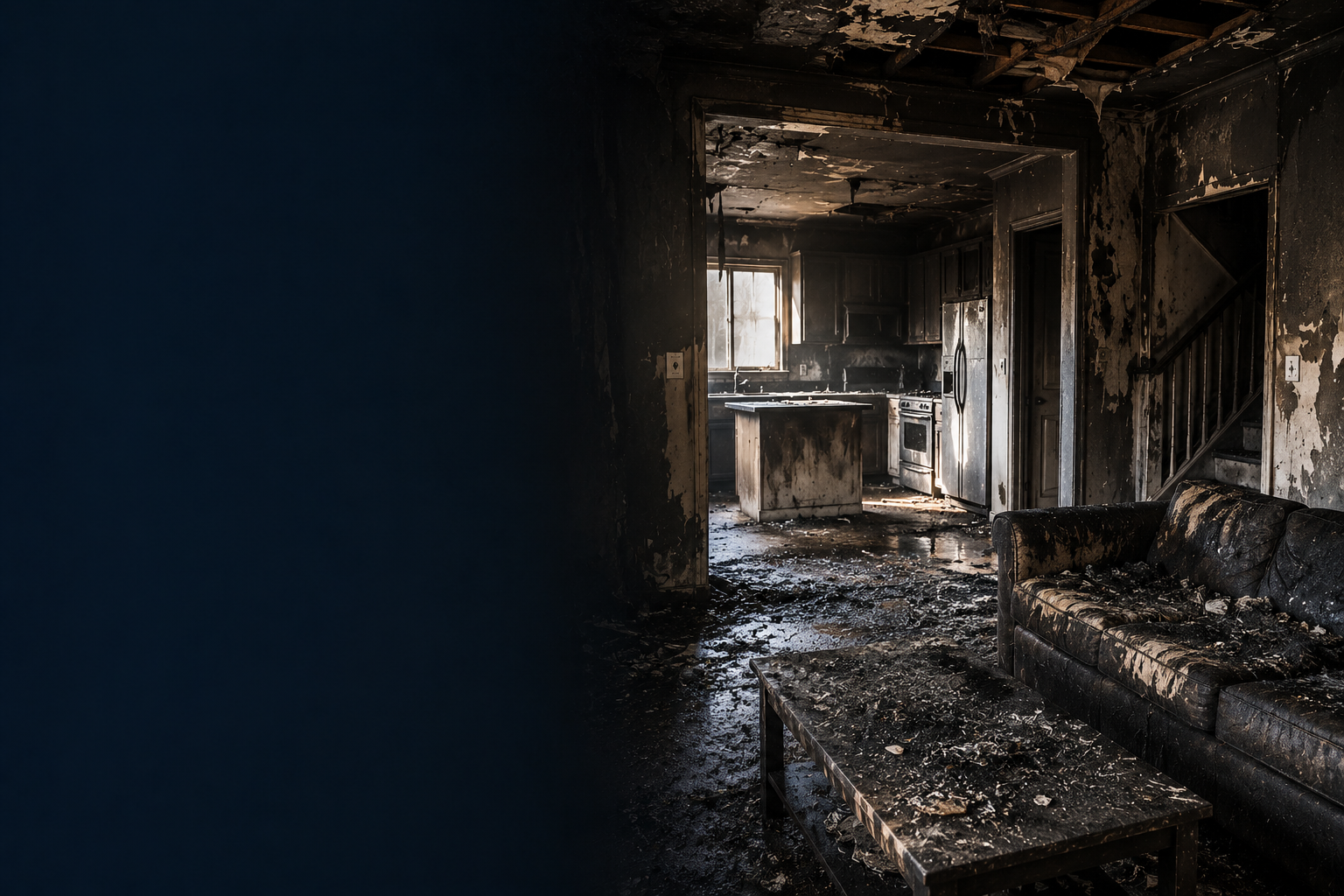
Kitchens are dense with surfaces and belongings, and each material needs a different approach. Grease residue collects heavily on the underside and interior of upper cabinets, inside the range hood, and on the tops of the fridge and cabinets where warm greasy air rises and settles. Cabinet boxes and doors usually clean and refinish well; heavily charred faces or delaminated particleboard may need replacement.
Contents — dishes, small appliances, cookware, pantry goods — get sorted into what’s cleanable and what isn’t. Sealed and washable items are degreased and sanitized; porous items that absorbed odor (unsealed wood, some plastics) and any food exposed to smoke or extinguisher chemicals get documented and discarded. Countertops, backsplash tile, and grout are degreased and, where the residue etched in, sealed. The goal is methodical: clean what can be saved, document what can’t, and give you an itemized record either way — which matters enormously for the insurance side.
Where fire damage extends past the kitchen into structure, we coordinate the full fire damage cleanup scope — soot removal, sealing, deodorization, and reconstruction — as one continuous project rather than a patchwork of separate trades.
The professional cleanup process, step by step
A proper Las Vegas kitchen fire restoration follows a deliberate sequence. Skipping or reordering steps is what leaves smells and stains behind:
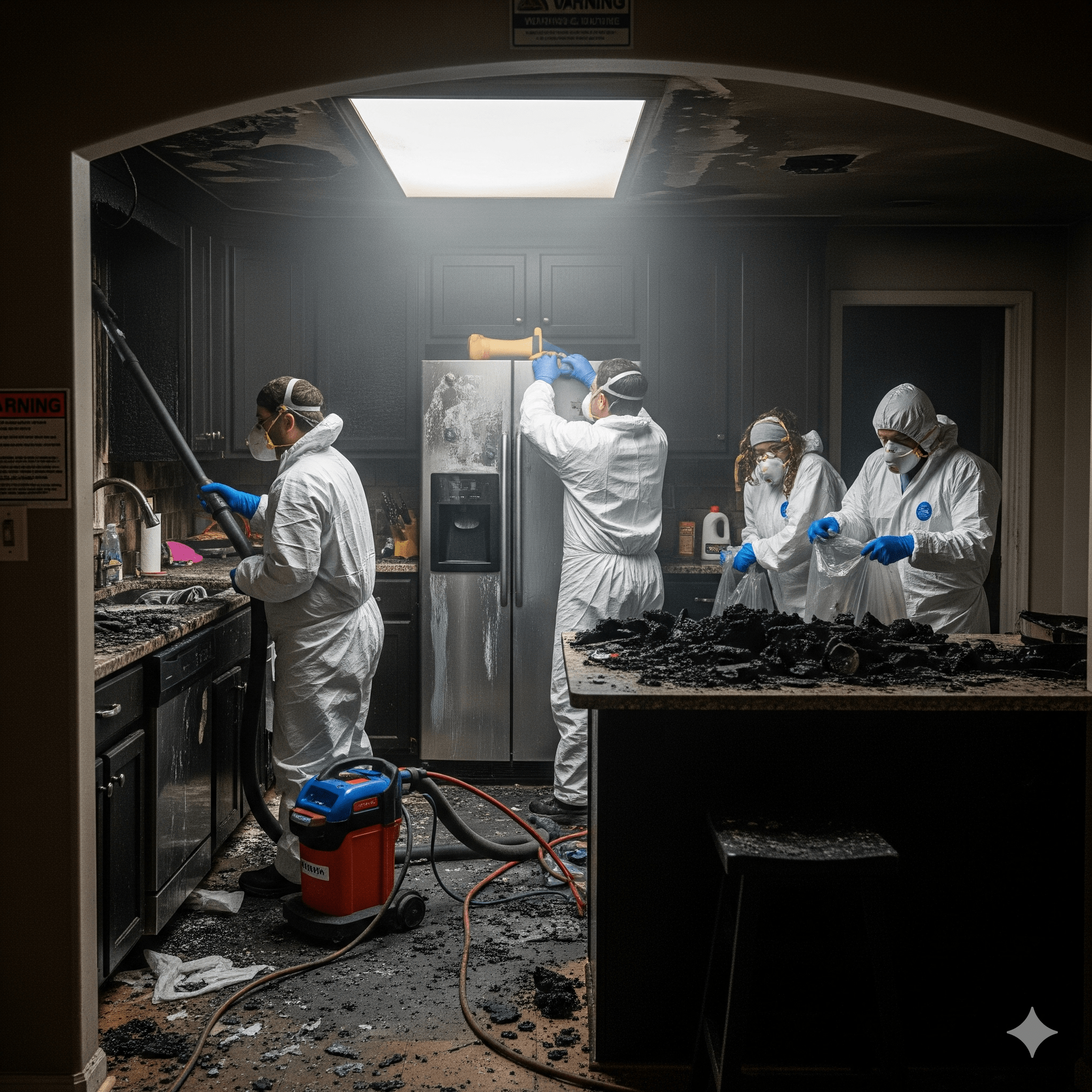
- Assessment & containment. Map the residue spread (including HVAC), photograph everything, and contain the work area with plastic and negative air so cleaning doesn’t push soot into clean rooms.
- Source removal. Remove and bag charred debris, burned materials, and unsalvageable contents. You can’t deodorize a room that still contains the burnt fuel — the smell source has to leave first.
- Dry soot removal. Chemical/dry sponges and HEPA vacuuming lift the greasy film off walls, ceilings, and cabinets working top-down, clean-to-dirty, before any wet cleaning.
- Degreasing & wet cleaning. Surface-appropriate degreasers dissolve the protein residue on hard surfaces, cabinet interiors, tile, and fixtures.
- HVAC & contents. Address ducts, filters, and registers; clean, deodorize, and inventory salvageable belongings.
- Deodorization. Neutralize odor at the molecular level (details below) — not mask it.
- Sealing & restoration. Seal any residual-stained surfaces with a stain/odor-blocking primer, then repaint and rebuild as needed so the finished kitchen shows no trace of the fire.
Deodorization: source removal first, then hydroxyl
Odor is where DIY and even some contractors fall short, because they reach for air fresheners and ozone before doing the unglamorous work. Effective smoke deodorization is sequential, and order is everything:
1. Remove the source. No machine can outrun burnt material still sitting in the house. Charred debris, saturated contents, and heavily damaged materials come out first. This single step removes the majority of the odor.
2. Clean every affected surface. The residue is the smell. Thorough degreasing and soot removal on walls, cabinets, ducts, and contents eliminates most of what’s left.
3. Neutralize what remains with hydroxyl technology. Odor molecules soak into porous drywall, wood, and fabric where cleaning can’t fully reach. Hydroxyl generators produce hydroxyl radicals that break down those trapped odor compounds at the molecular level. We favor hydroxyl for occupied homes because, unlike ozone, it’s safe to run while people and pets are present — so your family isn’t displaced longer than necessary. For severe cases we may stage additional treatment, but the principle holds: you deodorize by removing and neutralizing the odor, never by covering it. If a company’s plan starts with fragrance, that smell is coming back.
Insurance documentation that protects your claim
Most kitchen fires are covered under a standard Nevada homeowners policy, and the difference between a smooth claim and a fight is documentation. Before cleanup starts, we photograph and video the full scope, build a room-by-room inventory of damaged structure and contents, and record the affected areas — including the ones that aren’t obvious, like HVAC contamination and residue in rooms away from the kitchen. That itemized record is what an adjuster needs to approve the full scope rather than just the visible char.
We work directly with your insurer and adjuster, provide detailed line-item estimates, and document every step so nothing gets denied for lack of proof. If you’re at the very start, do two things: photograph everything before you move or clean anything, and call your carrier to open a claim. Then reach out through our contact page and we’ll coordinate the rest. A little discipline on documentation in the first hour protects thousands of dollars later.
What kitchen fire cleanup costs in Las Vegas
Cost depends on how far the smoke traveled, how porous the affected materials are, and whether the fire damaged structure or only deposited residue. These are realistic planning ranges for the Las Vegas Valley:
| Scope | What’s involved | Typical Las Vegas range |
|---|---|---|
| Contained stovetop fire | Localized soot/grease removal, one-room degrease & deodorize | $900 – $2,500 |
| Kitchen + smoke spread | Adjacent rooms, cabinet cleaning/refinish, HVAC cleaning, hydroxyl | $2,500 – $6,500 |
| Whole-home smoke & odor | Multi-room residue, duct decontamination, contents, sealing | $6,500 – $15,000 |
| Structural fire damage | Charred framing/drywall, cabinet replacement, reconstruction | $15,000 – $45,000+ |
These are planning ranges to set expectations, not a quote. Actual pricing depends on square footage, materials, the extent of smoke travel, and reconstruction needs — and most of it is typically covered by insurance. We provide a written, itemized estimate after an on-site assessment.
Frequently asked questions
Can I just clean up a small grease fire myself?
For a truly minor flare-up with no smoke spread, careful cleaning may be enough. The risk is that grease-fire residue is nearly invisible and spreads through the HVAC, so what looks like a small job often isn’t. If you smell lingering burnt-oil odor after cleaning, or the A/C was running, have it professionally assessed before residue etches surfaces and the smell sets in.
Why does my kitchen still smell like smoke after I cleaned everything?
Because odor lives in porous materials — drywall, cabinet interiors, insulation — and in your ductwork, which surface cleaning can’t reach. The smell also intensifies as grease residue oxidizes over the following days. Full odor removal requires source removal, thorough degreasing, and hydroxyl treatment to neutralize what’s trapped, not just cleaning what you can see.
Do I need to turn off my air conditioning after a kitchen fire?
Yes. Running the HVAC pulls greasy smoke into the return vents and blows it through the ducts into every room, spreading a one-room fire across the whole house. Switch the system off and leave it off until it’s been inspected — it’s one of the most valuable things you can do before restoration begins.
Is smoke and soot residue actually harmful to my health?
Smoke residue is slightly acidic and can irritate skin, eyes, and airways, and fine soot particles are unhealthy to breathe — especially for children, older adults, and anyone with respiratory conditions. That’s a good reason to keep the area ventilated (windows, not the A/C), avoid disturbing the residue, and let a crew with proper equipment handle the cleanup.
Will my homeowners insurance cover kitchen fire cleanup?
Most standard Nevada homeowners policies cover accidental kitchen fires, including smoke and soot damage. Coverage hinges on documentation, so photograph everything before cleaning and open a claim with your carrier. We work directly with adjusters and provide itemized estimates to help get the full scope approved.
How soon should I call after a kitchen fire?
As soon as the fire is out and it’s safe. Smoke residue is corrosive and grease-fire odor worsens over the following days, so the sooner residue is removed the less permanent damage and cost you face. Early documentation also strengthens your insurance claim — for full fire damage cleanup, calling in the first day makes a real difference.
LOCAL. CERTIFIED. READY TO HELP.
Need Property Restoration or Cleanup in the Las Vegas Valley?
Whether it’s water damage, mold, asbestos, fire and smoke, or a biohazard situation, Pinpoint Property Services can help you understand the next step.
Contact Pinpoint Property Services Today for a Free Inspection:

