
Popcorn Ceilings and Asbestos in the Vegas Valley: A Homeowner’s Guide
If your Las Vegas or Henderson home was built before the mid-1980s, that textured “popcorn” ceiling overhead may contain asbestos. It is not a reason to panic. Undisturbed and in good condition, those ceilings are generally safe to live with.
The risk shows up the moment the material is disturbed — a remodel, a water leak, a scrape-and-paint project, or impact damage. That is when microscopic fibers can become airborne. This guide walks through how to tell whether your ceiling is a concern, who tests it, who removes it, what it typically costs in the Vegas Valley, and how the abatement process actually works.
Quick Facts
Most at risk: Homes built before about 1980, especially with original popcorn ceilings, vinyl flooring, or pipe insulation.
Who tests: An independent, accredited asbestos inspector collects samples and sends them to an accredited lab. Pinpoint does not test in-house — an independent result keeps it unbiased.
Who removes: If a sample comes back positive, a licensed abatement contractor (that is us — Nevada license #0084981) safely removes and disposes of it under EPA NESHAP standards.
Local rule: In Clark County, accredited testing is generally required before renovation or demolition of pre-1980 materials.
Bottom line: Test first, then abate — and never scrape a suspect popcorn ceiling yourself.
In This Guide
- Asbestos and Popcorn Ceilings in the Vegas Valley
- Who Tests, Who Removes — and Why We Keep Them Separate
- Popcorn Ceiling Asbestos Removal Cost Guide
- Clark County and Nevada Asbestos Rules
- What Professional Abatement Looks Like
- When Asbestos Turns Up During a Remodel or Water Damage
- Pinpoint Field Note
- Frequently Asked Questions
Asbestos and popcorn ceilings in the Vegas Valley
Asbestos is a group of naturally occurring minerals that builders prized for decades because it resists heat, fire, and sound. It was mixed into all sorts of materials common in older Las Vegas homes — insulation, vinyl flooring and its adhesive, drywall joint compound, textured paints, and the sprayed-on “popcorn” texture used on ceilings.
Popcorn ceilings were popular partly because the texture hid imperfections in the drywall underneath. In Vegas Valley homes built before the late 1970s or early 1980s, asbestos was often blended into that texture for added fire resistance. The material itself is not the danger — disturbing it is. When asbestos-containing material is cut, sanded, drilled, scraped, or broken down by age or water, it releases tiny fibers you cannot see. Inhaled over time, those fibers are linked to serious illnesses including asbestosis, lung cancer, and mesothelioma, and there is no established safe level of exposure.

When to suspect asbestos in your popcorn ceiling
The biggest clue is the age of the home. If your ceiling was installed before 1980, treat it as suspect until proven otherwise — you cannot tell whether texture contains asbestos just by looking at it. The time to act is anytime you plan to disturb it: scraping it off, drilling for a fixture, or repairing it after a leak or impact. A cautious “assume it is positive until tested” approach is what prevents accidental exposure.
Common materials in pre-1980 Las Vegas homes that may contain asbestos:
- Ceilings: Popcorn and acoustic texture, plus some older drywall joint compounds.
- Flooring: Vinyl tiles, sheet-flooring backing, and the original mastic adhesive.
- Insulation: Pipe wrap, attic insulation, and vermiculite.
- Walls: Textured paints, patching compounds, and some cement boards.
Who tests, who removes — and why we keep them separate
This is the part most homeowners get tangled up in, so it is worth being clear. Testing and removal are two different jobs done by two different parties, and that separation is by design.
Testing is done by an independent, accredited inspector. They visit your home, identify suspect materials, carefully collect small samples of the ceiling texture, and send them to an accredited laboratory for analysis. The lab confirms whether asbestos is present, what type, and in what concentration. Pinpoint does not perform this testing in-house, and that is intentional — an independent lab gives you an unbiased result, with no incentive to find a problem that is not there. If you need a tester, call us and we will refer you to a trusted accredited inspector.
Removal is done by a licensed abatement contractor. If the lab result comes back positive and the material needs to come out, that is our lane. Pinpoint is a licensed Nevada abatement contractor (license #0084981), and we safely contain, remove, and dispose of asbestos-containing materials under EPA NESHAP standards. The only testing-type work we perform is air monitoring during our own abatement and clearance confirmation on our own jobs — never the upfront diagnostic sampling that determines whether you have a problem in the first place.
Keeping the inspector and the abatement contractor separate protects you: the party telling you whether you have asbestos has no stake in selling you a removal.
Popcorn ceiling asbestos removal cost guide
Cost is the first question most homeowners ask, and the honest answer is that it depends — on the square footage involved, how the home is laid out, the condition of the material, and whether the work is one room or the whole ceiling. The ranges below are typical estimates for the Las Vegas Valley to help you plan; they are not a quote. A specific number requires an on-site look.
| Step | Who performs it | Typical cost range |
|---|---|---|
| Asbestos lab test (bulk sample) | Independent accredited inspector | ~$50–$125 per sample; $400–$800 for a full inspection |
| Popcorn ceiling abatement — single room | Licensed abatement contractor | ~$1,000–$3,000 |
| Popcorn ceiling abatement — whole home | Licensed abatement contractor | ~$3,000–$15,000 |
| Air monitoring & post-abatement clearance | Performed during/after abatement | Varies by project |
Field Note: The cheapest path almost always looks like DIY scraping — until it spreads fibers through the HVAC system and turns a one-room job into a whole-home decontamination. The testing-and-abatement cost is small next to that.
Pinpoint provides free estimates for removal and abatement. The lab test itself is billed by the independent inspector, not by us.
Clark County and Nevada asbestos rules
Local rules exist to keep fibers out of the air — both yours and your neighbors’. In Clark County, if your property was built before 1980, accredited asbestos testing is generally required before you carry out renovation or demolition that could disturb suspect materials like popcorn ceilings, old flooring, or insulation. The Clark County Division of Air Quality publishes the forms and requirements.
NESHAP standards for abatement
When asbestos is confirmed and needs to be removed, the work follows the EPA’s National Emission Standards for Hazardous Air Pollutants (NESHAP). These standards govern how asbestos-containing materials are contained, wetted to suppress dust, packaged, and disposed of so fibers do not escape into your home or the surrounding neighborhood. You can review the EPA’s guidance for building owners and its how-to-protect-your-family page for the federal picture.
Why licensed matters
Because of the health risks and the regulations, asbestos removal is not a job for an unlicensed handyman. A licensed, certified abatement contractor has the training, equipment, and disposal access to do it safely and legally — and to keep you clear of the fines and liability that come with mishandling it. Pinpoint holds Nevada license #0084981 and works to NESHAP standards on every abatement.
What professional abatement looks like
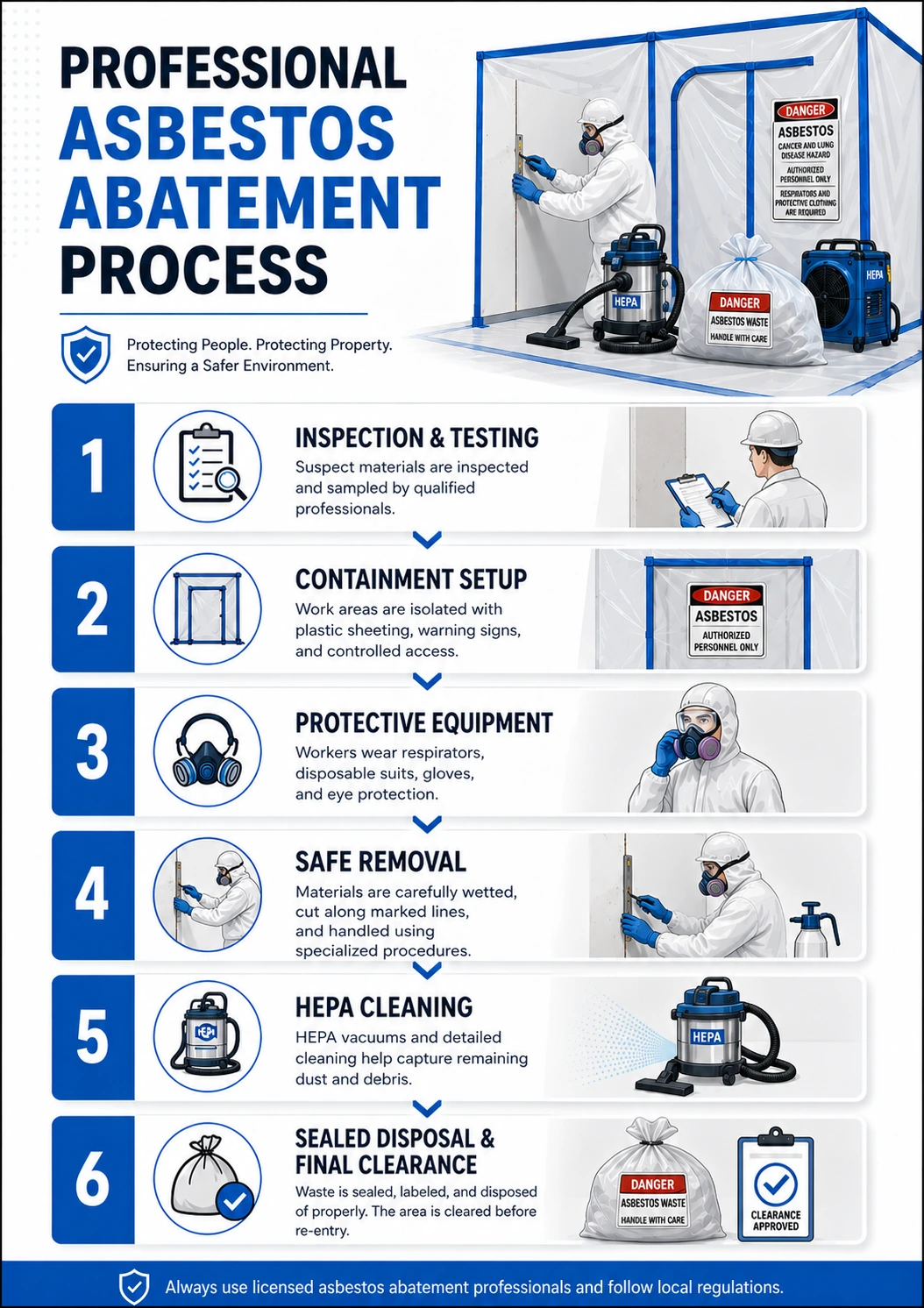
Once an independent inspector confirms asbestos, our abatement team takes over. The process is methodical, and every step is about keeping fibers contained.
Containment and negative air
We seal off the affected rooms with heavy plastic sheeting and run negative-air machines fitted with HEPA filters. Air inside the work zone is pulled through filtration so fibers cannot drift into the rest of the home or the HVAC system.
Wet removal and sealed disposal
Our technicians work in protective gear and wet the material first to keep fibers from going airborne. The texture is removed carefully, and everything that comes down is sealed immediately into labeled, heavy-duty bags. That waste is transported to a facility licensed to handle asbestos — not your curb.
Air monitoring and clearance
We monitor the air during the work and confirm clearance afterward, so the space is verified safe before anyone re-enters and before any rebuild begins. For a deeper look at how we approach it, see our asbestos abatement process and our asbestos removal in Las Vegas service.

When asbestos turns up during a remodel or water damage
A lot of asbestos discoveries happen mid-project. You start a small repair — patching a wall, fixing a leak — and uncover something suspect. In pre-1980 Vegas Valley homes, that “something” is often asbestos. If a remodel is what’s on your calendar, start with our guide on whether you need an asbestos test before remodeling a Las Vegas home.
Stop work and get it tested
If you or your contractor uncovers crumbling pipe insulation, aged vinyl flooring, or popcorn texture you are about to scrape, the right move is to stop. Cutting, sanding, or tearing through it can spread fibers throughout the home, including into the HVAC system, turning a small repair into a much larger and costlier contamination problem. Pause, and have an accredited inspector sample it.
Coordinating abatement with restoration
Water damage is a frequent trigger. When drywall, ceiling texture, or insulation gets wet and has to come out during drying and repair, any asbestos in those materials has to be handled first. There is no point drying a space only to re-contaminate it during the rebuild. Because Pinpoint handles both water damage restoration and asbestos abatement, we can sequence the two so the area is contained, cleared, and only then rebuilt — one coordinated plan instead of two contractors pointing at each other.
Pinpoint Field Note
Pinpoint Field Note
The pattern we see most often in Vegas Valley popcorn-ceiling jobs is a homeowner who was one weekend away from scraping the ceiling themselves. The home is from the 1970s, the texture is original, and the plan was a quick refresh before listing or after a leak. The fix is almost always cheaper and faster than they fear — but only when the sequence is right: independent test first, abatement second, rebuild third.
The expensive jobs are the ones where that order got skipped. Once dry-scraped texture has been swept up and tracked through the house and the air handler, you are no longer abating a ceiling — you are decontaminating a home. Slow down for the test. It is the single decision that keeps these projects small.
— Pinpoint Property Services, Field Observation
Frequently asked questions
What is asbestos and why is it dangerous?
Asbestos is a group of minerals once used in building materials because it resists heat and fire. The danger comes when those materials are disturbed: tiny fibers become airborne, and if inhaled they can lodge in the lungs and lead to serious illness years later, including lung cancer and mesothelioma. There is no established safe level of exposure, which is why suspect materials are handled so carefully.
How can I tell if my popcorn ceiling has asbestos?
You cannot tell just by looking — asbestos is invisible in the texture. The strongest clue is age: if the ceiling was installed before 1980, there is a real chance it contains asbestos. The only way to know for certain is to have an accredited inspector take a small sample and send it to a lab.
Can I just paint over a popcorn ceiling I think has asbestos?
Painting can temporarily seal the surface, but it does not remove the hazard. If the ceiling is later damaged by a leak or a remodel, the fibers can still become airborne. If you are concerned, the safer path is to have it tested and, if positive, properly removed.
What is the difference between asbestos testing and removal?
They are two separate jobs done by two separate parties. Testing is performed by an independent, accredited inspector who samples the material and has a lab confirm whether asbestos is present. Removal, or abatement, is performed by a licensed contractor once a result comes back positive. Keeping them separate means the party that tells you whether you have asbestos has no stake in selling you the removal.
How much does it cost to remove an asbestos popcorn ceiling in Las Vegas?
It depends on square footage, layout, and whether it is one room or the whole ceiling. As a planning guide for the Las Vegas Valley, a single room often runs about $1,000 to $3,000 and a whole home roughly $3,000 to $15,000, with the lab test billed separately by the independent inspector. Those are estimates, not quotes — Pinpoint provides a free on-site removal estimate.
Do I need to leave my house during asbestos removal?
Usually, yes — at least to stay clear of the work area. The team seals off the space and runs negative-air filtration to keep fibers contained, and it is safest for everyone to be away from the containment zone during removal.
What happens if asbestos turns up during a renovation?
Stop work in that area immediately and do not try to clean it up yourself. Have an accredited inspector sample the material, and if it is positive, bring in a licensed abatement contractor to remove or contain it before the renovation continues. It can add time and cost, but it prevents spreading fibers through the home.
How do I choose a qualified asbestos abatement contractor in Las Vegas?
Confirm they are licensed and certified for asbestos work in Nevada, ask for proof of current certifications, and look for experience with popcorn-ceiling removal specifically. A reputable contractor will walk you through a written plan covering containment, removal, disposal, and air monitoring that follows NESHAP standards.
LOCAL. CERTIFIED. READY TO HELP.
Need Property Restoration or Cleanup in the Las Vegas Valley?
Whether it’s water damage, mold, asbestos, fire and smoke, or a biohazard situation, Pinpoint Property Services can help you understand the next step.
Contact Pinpoint Property Services Today for a Free Inspection:

