
Water Damaged Cabinets: 7 Critical Checks Before Repair
The dishwasher leak is stopped. The kitchen floor has been wiped down. But the cabinet beside the appliance has a swollen bottom edge, the toe-kick has gone soft, and now you are facing a much bigger question: does one damaged cabinet mean replacing the whole kitchen?
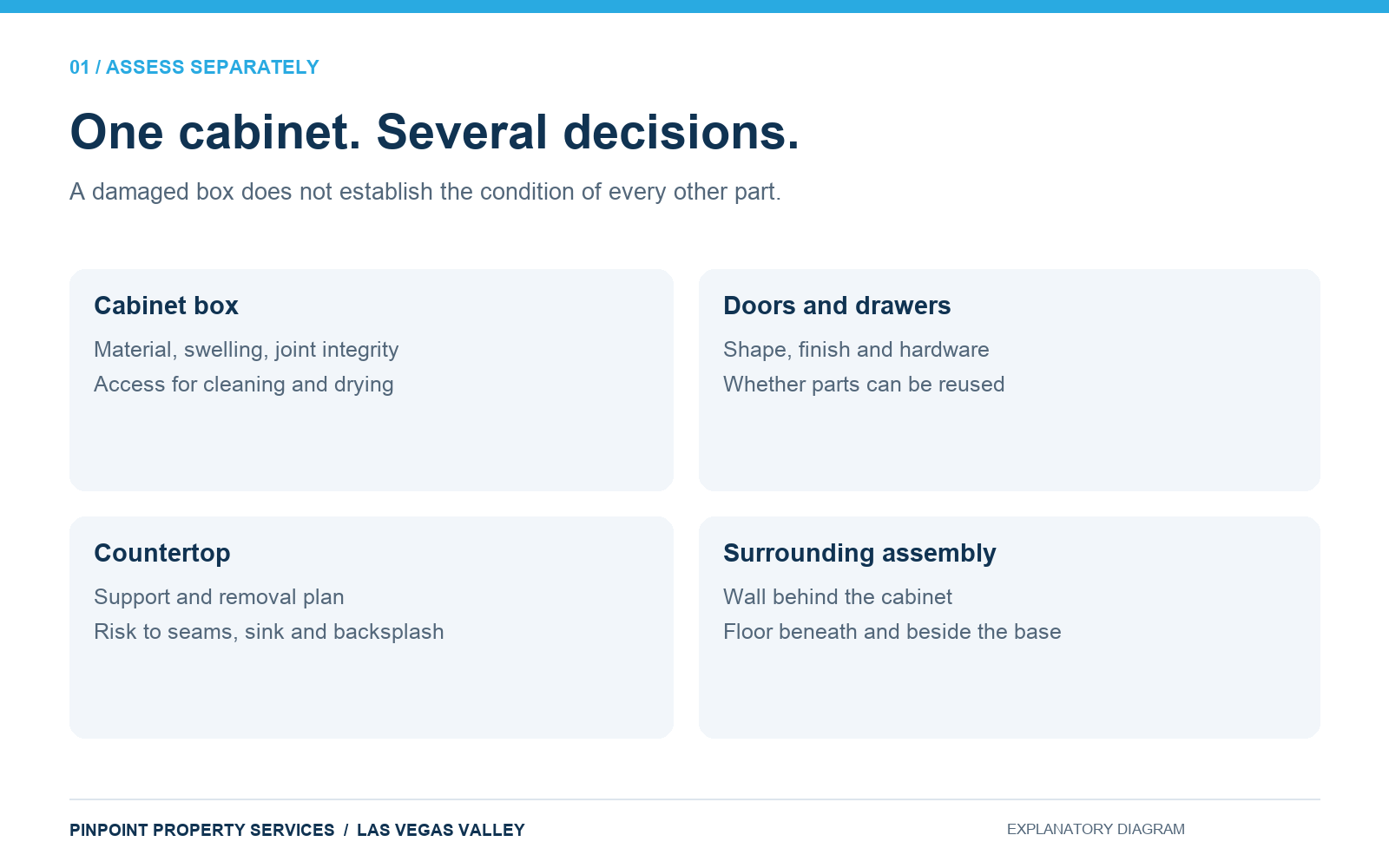
Usually it does not. Water damaged cabinets fail one component at a time, and the component that fails first is almost never the one you are looking at. The door you can see is often fine. The cabinet floor underneath the sink, hidden behind that door, is where the water actually sat.
We restore kitchens across Las Vegas, Henderson and Summerlin, and the single most expensive mistake we see homeowners make is approving a whole-kitchen replacement from a photograph — or refinishing a cabinet that was never going to hold. This guide covers the seven checks that separate necessary restoration from finish choices, so you know what you are approving before the crew arrives.
QUICK FACTS
- A cabinet door, box, base and countertop can each have a different salvage outcome.
- What the cabinet is made of matters more than how wet it looks — particleboard and plywood fail differently.
- A good-looking front tells you nothing about the concealed back, the toe-kick or the floor beneath.
- Removal for access and replacement because of damage are two different line items. Ask which one you are paying for.
- In Las Vegas the surface dries long before the cavity does. Dry to the touch is not dry.
- Golden rule: approve a documented scope, not a whole-kitchen verdict.
1. Before assessing water damaged cabinets, establish the source
A failed supply line, a leaking drain and water entering from outside are not interchangeable situations, and the difference changes what can be saved. The IICRC S500 standard we work to sorts water into three categories: clean water from a supply line, grey water carrying contaminants such as dishwasher or washing machine discharge, and black water from sewage or ground intrusion.
That category drives the cabinet decision more than most homeowners expect. Clean water that sat briefly on a sealed surface is a drying problem. Contaminated water that soaked into a porous cabinet base is a different conversation, because you cannot reliably clean the inside of a saturated composite panel — you can only remove it.
So tell us three things when we arrive: what leaked, when you first noticed it, and whether the leak has been repaired. If you do not know how long it ran, say so. That uncertainty belongs in the assessment rather than being smoothed over, and it is the honest basis for deciding what gets opened up.
Before any of that, stay clear of standing water near electrical equipment. Do not reach behind a wet dishwasher to disconnect it, and do not drag a heavy appliance out to investigate. Have a qualified professional address the source and any electrical concerns first.
The EPA’s water-damage guidance distinguishes clean-water cleanup from contaminated-water situations and cautions against running fans before you know which one you have. Pointing a household fan into an unknown cabinet cavity can push contaminated aerosols through the rest of the kitchen, so it is a poor first experiment.
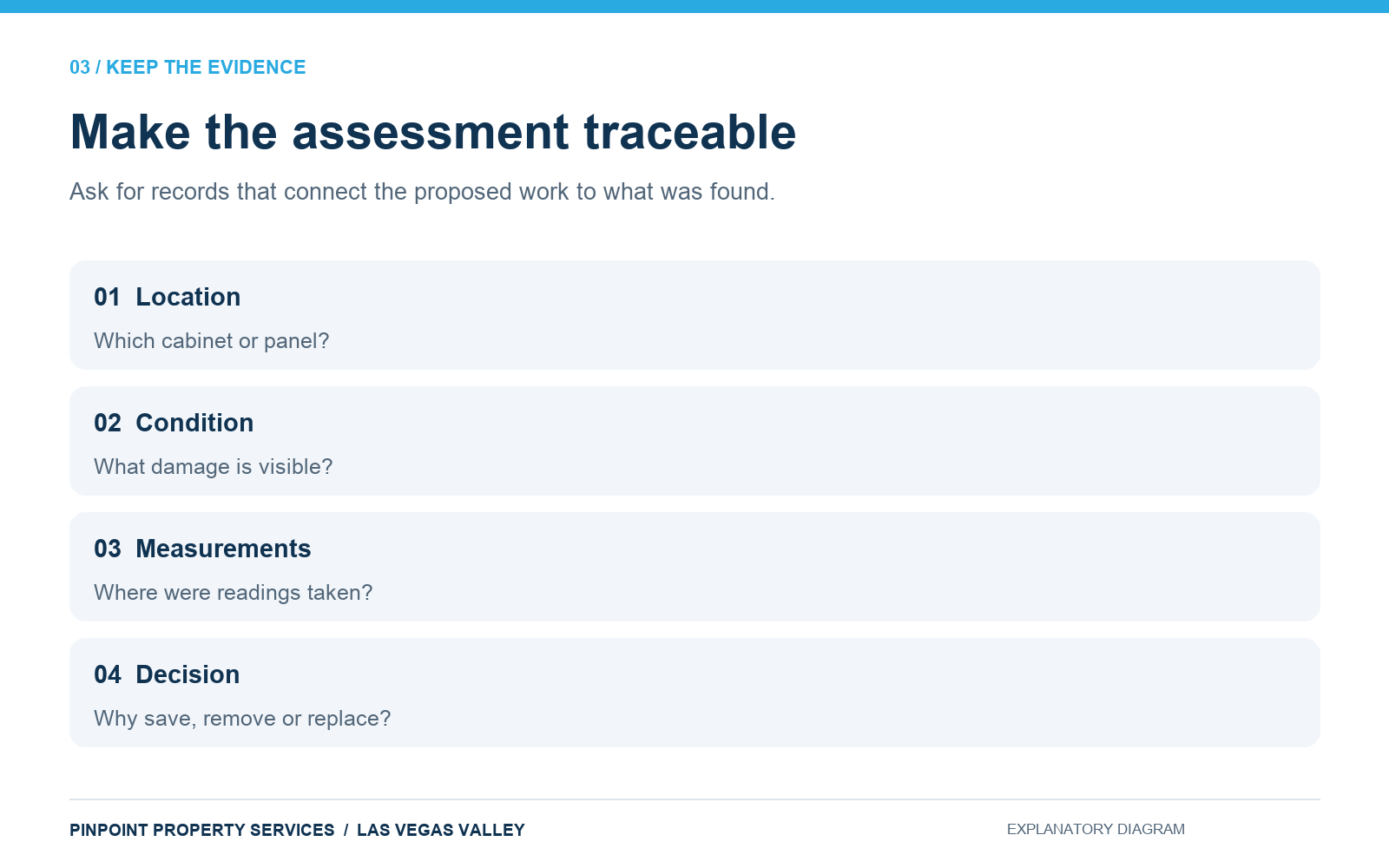
Once the area is safe, photograph the affected run from across the room, then take closer pictures of the visible damage. Include the adjacent flooring and the inside of the sink cabinet. You are recording the starting condition — not proving the final extent of the loss.
2. Identify what your water damaged cabinets are made of
“Wood cabinets” is too broad a description to make a repair decision from. A typical Las Vegas Valley kitchen has solid-wood or MDF doors hung on a box built from particleboard or plywood, with a separate decorative end panel and a toe-kick that is often the thinnest material in the whole assembly. The part you see from the room is frequently not the part nearest the leak.
The distinction matters because these materials fail in genuinely different ways:
- Particleboard and MDF are wood fibers bound with adhesive and compressed under pressure. When they absorb water the fibers swell and push apart, and drying does not restore the compression. A swollen particleboard cabinet floor stays swollen. This is the most common irreversible failure we find.
- Plywood holds up considerably better, because its cross-laminated veneers restrain movement in both directions. Its failure mode is delamination — the glue line letting go — which shows as layers separating at an edge.
- Solid wood swells and shrinks with moisture and often recovers enough to be dried, sanded and refinished. What tends not to recover are the joints, which can loosen as the wood moves.
There is a second problem with composite boxes: the finished face is a laminate or thermofoil skin that acts as a vapor retarder. It slows drying from the room side, so a cabinet can keep a wet core behind a surface that feels perfectly dry. That is why we take readings in the material rather than judging by touch.
So ask the assessor to name the affected component and its construction, not just the room. Is the concern a removable shelf, the cabinet floor beneath the sink, a side panel carrying the load, or the back against the wall? If the material cannot be identified without access, that should stay an open question rather than becoming an assumption.
From the field: the sink base is the cabinet we open first, and it is the one that most often decides the scope. It takes the slow leaks, it is usually the lowest point water reaches, and its floor panel is commonly the thinnest composite in the kitchen. A kitchen where only the sink base has failed is a very different job from one where the run beside it has gone too — and you cannot tell those apart from the doors.
Dig out any cabinet order, manufacturer label or remodel paperwork you still have. A finish name or an installation photograph helps a cabinet specialist discuss matching later, although neither tells you whether the existing assembly can be saved.
3. Separate cosmetic damage from a failed component
A water mark and a panel that has lost its integrity call for completely different work. The signs that point to real failure are visible swelling along a bottom edge, layers separating at a cut edge, joints that have opened, a cabinet floor that sags underfoot, and doors that no longer sit square in their openings. Do not press, pry or load a damaged part to see how much it will take.
Those signs tell you where to look closely; they do not settle the repair on their own. A sticking door might be a hinge that has dropped, a door that has distorted, or a box that has moved out of square beneath it. Ask which one is responsible before you accept a hinge adjustment as the fix, because adjusting hardware on a failing box just buys a few weeks.
A drying plan also needs an honest repairability check alongside it. Removing moisture does not reverse crumbling composite, re-close a failed glue line, or make a lifted laminate lie back down. The reverse is equally true: a finish blemish on a plywood box is not a reason to replace a kitchen run.
For each affected component we want a clear disposition — retain and dry, evaluate after drying, remove for access and assess for reuse, or replace. “Evaluate after drying” is a legitimate answer when it comes with what will be checked, who checks it, and what result sends it to replacement.
4. Check behind and beneath the cabinet run
The cabinet front is one small part of the assessment. The back panel sits against the wall, the toe-kick cavity runs the length of the base units, and the flooring may continue under the cabinets, stop at their edges, or come in more than one layer. Water travels through all of it before anyone sees a stain.
The EPA’s guidance on investigating moisture and mold addresses hidden damage and the use of moisture meters on building materials, and notes that mold can begin growing on damp materials within 24 to 48 hours. That window is why the toe-kick cavity matters so much: it is enclosed, unventilated and almost never checked.
Ask where readings were taken, what could not be reached, and whether more investigation is needed before the scope is called final. One reading from an accessible cabinet face does not answer the question about the wall behind it.
This is also where the Las Vegas climate misleads people. Our dry air pulls moisture out of exposed surfaces quickly, so a kitchen can feel completely normal within a day while the cavity behind the toe-kick is still holding water. Low humidity speeds up the drying you can see and does nothing for the drying you cannot. We work from meter readings in the affected materials, not from how the room feels.
If suspected mold turns up, disturbance should stop and the work plan should be reassessed. Pinpoint provides mold removal following IICRC S520. Standalone diagnostic testing is referred to an independent accredited inspector — it is not something we perform ourselves, which keeps the party identifying the problem separate from the party paid to fix it.
5. Plan access before anyone removes a cabinet
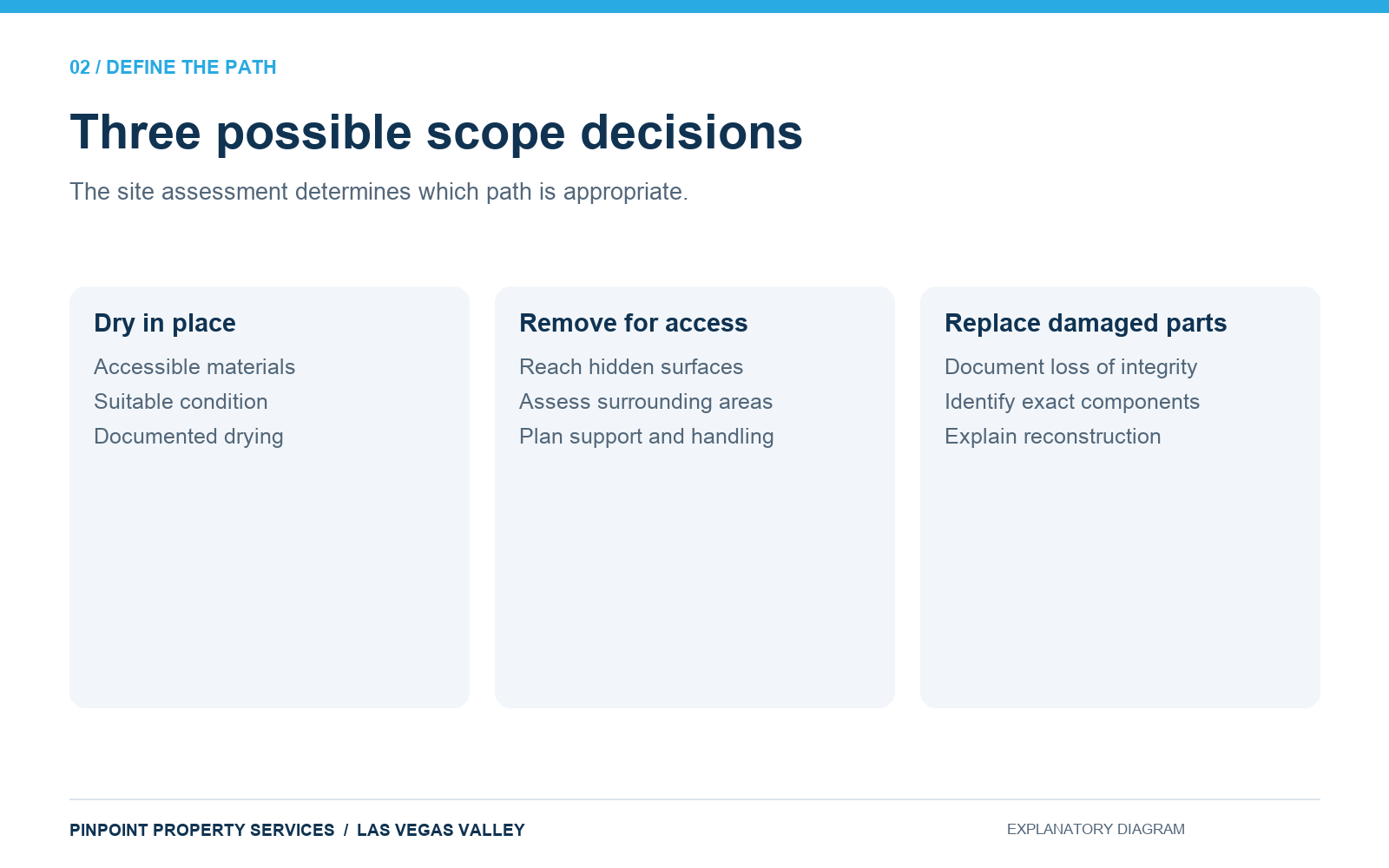
A cabinet comes out for one of two reasons: it is damaged, or something behind it needs to be reached. Sometimes both. Ask which reason applies to each unit, because it changes whether careful removal for reuse is worth the labor and what has to happen before anything goes back.
Countertops, sinks, backsplashes, plumbing and appliances all complicate that plan. A stone countertop spanning a run of base cabinets needs its support worked out before a single unit is pulled, and reuse should never be promised from photographs. Have the relevant trades explain how the assembly will be supported, disconnected, protected and reinstalled.
Before you approve removal, ask what adjacent finishes are likely to be damaged in the process and how discoveries will be handled when they appear. If older or suspect building materials will be disturbed, that assessment belongs before demolition, not during it. You should never be asked to cut into concealed materials yourself to speed up an estimate.
Then there are the practical arrangements, which matter more than people expect in a kitchen. Confirm whether the sink, dishwasher and food-preparation area stay usable during each phase, set up a temporary washing and meal area if they do not, and keep children and pets out of the work zone.
6. Compare written options for water damaged cabinets
A useful estimate says what is being kept, what is being removed, and why each decision was made. Ask for restoration work, cabinet work and related trade work to be identified separately, so two proposals can be compared against the same scope instead of against each other’s optimism.
| Possible approach | Question it must answer | What to document |
|---|---|---|
| Retain and dry in place | Can the affected areas be reached, and will the retained material stay serviceable? | Access plan, monitoring points, and completion criteria. |
| Remove for possible reuse | Can the assembly be handled without unacceptable damage? | Handling risks, storage, assessment, and reinstallation scope. |
| Replace a component or cabinet | Which part has failed or cannot be acceptably restored? | Damage evidence, dimensions, materials, and finish options. |
| Broader cabinet replacement | What additional damage, construction constraint, or owner choice expands the work? | Necessary repairs separated from elective changes. |
Matching is worth raising early rather than discovering at the end. A discontinued door profile, an unavailable finish or simply a decade of light exposure can mean a replacement cabinet will not disappear into the run. Ask for samples or a written explanation of the proposed match, and decide then whether a partial replacement is acceptable to you.
The same discipline applies to cost. A price without a defined scope cannot be compared to anything. Ask whether the figure includes access, disposal, drying, countertop handling, plumbing reconnection, cabinet installation and finish repairs, and get the exclusions and provisional items identified in writing before work starts.
7. Agree on the evidence needed before repairs are closed up
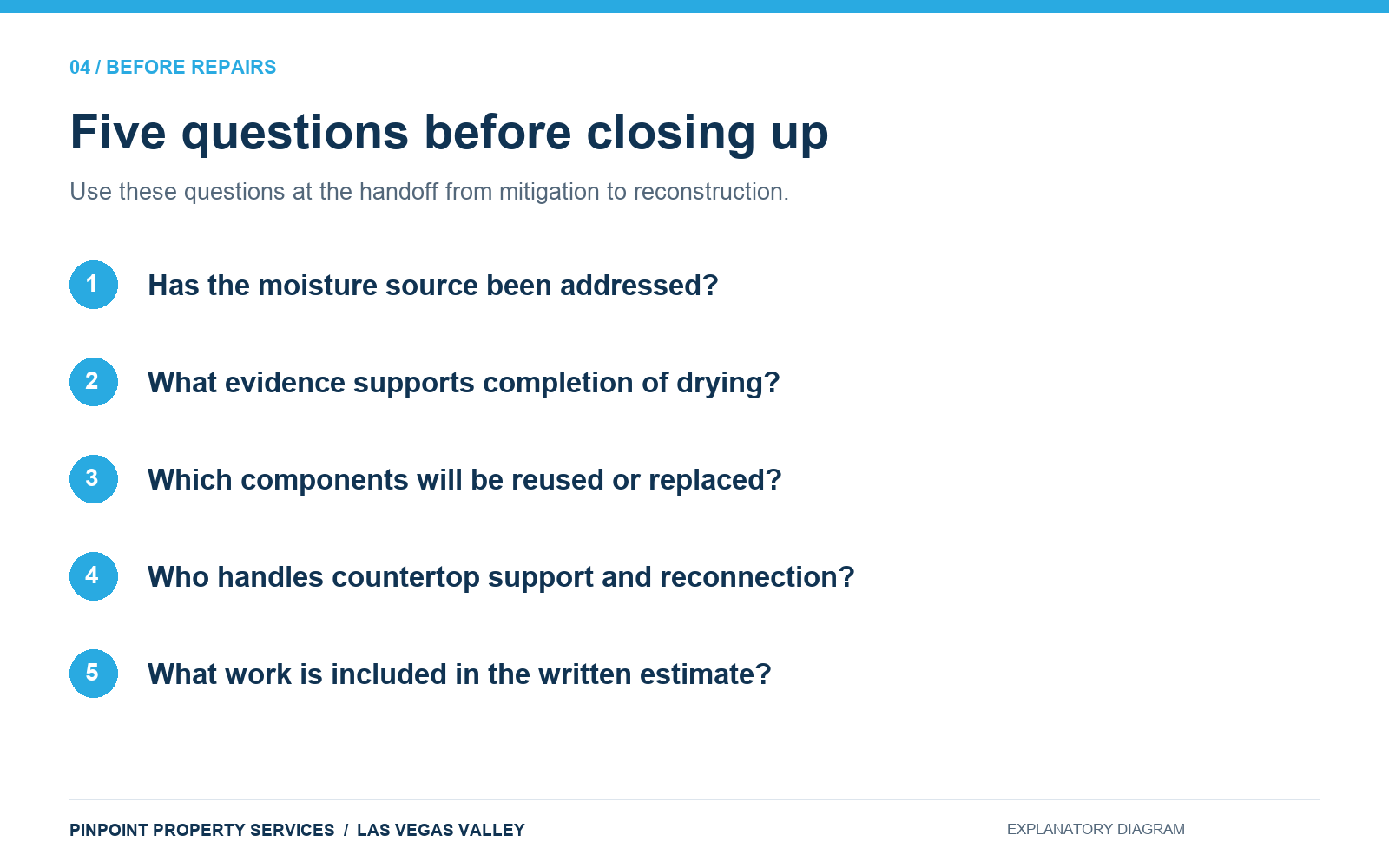
Before the kitchen is reassembled, agree what actually demonstrates the affected area is ready. That conversation should cover the repaired water source, the documented drying result, the condition of every retained component, and anything still outstanding.
Keep the initial photographs, the agreed scope, the approved changes and the completion records together in one place. If hidden damage changes the plan partway through — and in kitchens it often does — ask for the explanation to be tied to the newly exposed area, so the sequence still makes sense months later when different trades have each done their part.
At the final walkthrough, check the work against the written scope rather than against your general impression: cabinet alignment, door and drawer operation, finish repairs, and every agreed reconnection. Write down anything unresolved instead of letting it vanish into a statement that the kitchen is finished.
Our water damage restoration work follows IICRC S500 and starts with an on-site assessment of what is actually wet, component by component. If you have a Las Vegas Valley kitchen with water damaged cabinets and you are not sure what can stay, contact Pinpoint or call (702) 869-3030 for a free, no-pressure on-site inspection and estimate. Nevada License #0084981.
Frequently asked questions
Can water damaged cabinets be saved?
Often, yes — but component by component rather than kitchen by kitchen. Solid wood and plywood frequently dry and refinish successfully. Particleboard and MDF that have swollen do not recover, because drying does not restore the compression lost when the fibers expanded. The water category matters too: material soaked by contaminated water generally has to be removed rather than cleaned.
Does a swollen cabinet mean the whole kitchen needs replacement?
No. It means that component failed and the area around it needs inspecting. Cabinets fail individually, and the sink base is usually first because it takes slow leaks and sits at the lowest point. Ask for a documented reason behind any broader replacement — damage found, a construction constraint, or finish matching — rather than accepting a whole-kitchen verdict.
Can I just repaint or refinish a stained cabinet?
Only once the leak is repaired, the material has been assessed for drying, and the component is confirmed as structurally sound. Paint covers a stain; it does not re-bond a delaminated panel, restore swollen particleboard, or deal with moisture still sitting behind the surface. Refinishing over a wet or failed substrate usually fails again within months.
Can the countertop stay if the base cabinets come out?
Sometimes, and it depends on the material, how it was installed, and how it will be supported while the cabinets beneath are removed. Stone and solid-surface tops spanning several units need a support plan worked out in advance. An undamaged-looking surface is not a guarantee of successful removal and reuse, so have qualified trades assess it before work begins.
How much does cabinet water damage repair cost in Las Vegas?
It depends on how many components failed, how much access is needed, whether drying or replacement is involved, and what related trade work follows. Rather than a single figure, ask for an itemized on-site estimate separating restoration, cabinetry, countertop handling and reconnections, with exclusions stated. Scope drives the number far more than the size of the kitchen does.
LOCAL. CERTIFIED. READY TO HELP.
Need Property Restoration or Cleanup in the Las Vegas Valley?
Whether it’s water damage, mold, asbestos, fire and smoke, or a biohazard situation, Pinpoint Property Services can help you understand the next step.
Contact Pinpoint Property Services Today for a Free Inspection:

